3D Point Cloud Annotation Services: Comparison
· Data Annotation
Compare top 3D point cloud annotation services, methods, QA, costs, and automation to choose the right provider for LiDAR, RADAR, or photogrammetry projects.
3D Point Cloud Annotation Services: Comparison
3D point cloud annotation services are essential for industries like autonomous driving, robotics, and geospatial mapping. These services label 3D datasets created by technologies such as LiDAR, RADAR, and photogrammetry, enabling machine learning models to interpret spatial environments accurately. Here's what you need to know:
- Annotation Types: Common methods include 3D bounding boxes (cuboids), semantic segmentation, and keypoint annotation, tailored to specific applications like object detection, navigation, and mapping.
- Quality Assurance: High-end providers use multi-layered validation, automated tools, and human review to ensure accuracy (95%-99%) and consistency.
- Pricing: Costs range from $1–$10 per image or $6–$12/hour for managed services, depending on complexity and accuracy requirements.
- Top Providers:
- Anolytics: Affordable, precise annotations for LiDAR, RADAR, and photogrammetry.
- Cogito Tech: Specializes in photogrammetry and geospatial modeling.
- Sama: Handles high-volume enterprise projects with sensor fusion tools.
- Keymakr: Focused on LiDAR camera applications for robotics and healthcare.
Quick Comparison
| Provider | Specialization | Data Types | Strengths | Best For |
|---|---|---|---|---|
| Anolytics | Autonomous Navigation | LiDAR, RADAR, Photogrammetry | 1 cm object detection precision | Infrastructure, agriculture |
| Cogito Tech | Geospatial & Agritech | LiDAR, RADAR, Photogrammetry | 2D-to-3D photogrammetry tagging | Remote sensing, defense |
| Sama | Ground Truth for Enterprise | LiDAR, RADAR, Sensor Fusion | High-volume processing | Large-scale AI projects |
| Keymakr | Smart Cities & Robotics | LiDAR Cameras | AI-based classification | Robotics, healthcare |
Key takeaway: Choose a provider that aligns with your project's data type, accuracy needs, and budget. Automation tools are speeding up annotation processes, but human review remains vital for safety-critical tasks.
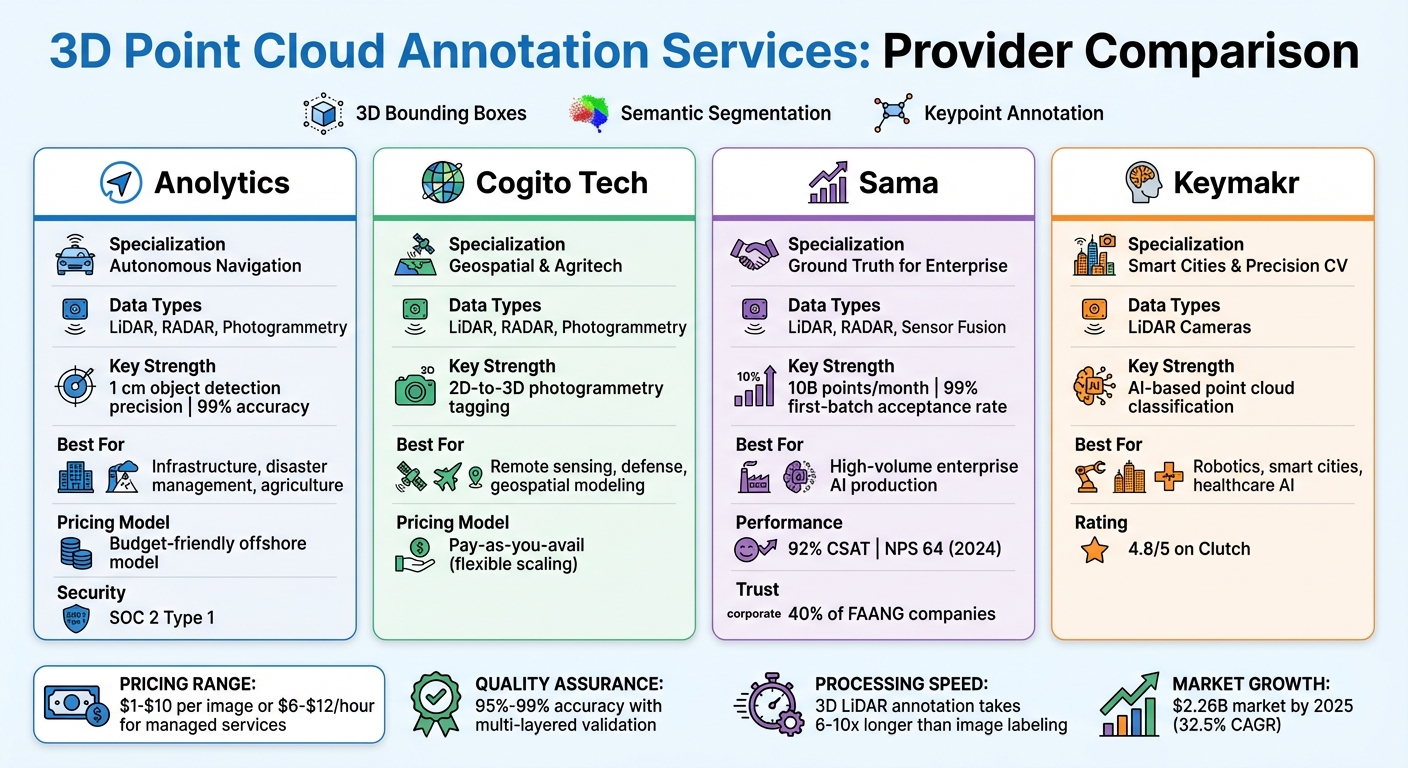
3D Point Cloud Annotation Service Providers Comparison Chart
Key Features of 3D Point Cloud Annotation Services
LiDAR, RADAR, and Photogrammetry Explained
LiDAR operates using laser pulses to measure distances, creating highly accurate 3D point clouds. Modern automotive LiDAR systems can generate millions of points per frame, but the density of these points decreases with distance. For instance, at 2 meters (about 6.5 feet), the density is around 1,000 points per square meter, but this drops to just 10 points per square meter at 20 meters (about 65 feet). RADAR, on the other hand, uses radio waves and Doppler shift to measure both distance and velocity, making it a reliable partner to LiDAR in sensor fusion setups, especially in challenging weather conditions. Photogrammetry reconstructs 3D surfaces from 2D images, creating dense datasets that require significant processing to align and filter the raw data.
These differences in data acquisition methods influence the complexity of annotation. As Karyna Naminas, CEO of Label Your Data, points out:
3D LiDAR annotation pipeline is taking 6-10x longer than image labeling.
To handle this complexity, annotation services rely on specialized tools, such as multi-view layouts (top, side, and front orthogonal views) and 3D viewports, which help annotators position cuboids accurately. Many platforms also integrate LiDAR point clouds with 2D camera images (RGB), allowing annotators to identify objects that might otherwise appear as sparse dots in 3D space. Supporting various file formats - like .PCD, .BIN, .LAS, and .PLY - is equally important, as each format is tailored to specific applications, such as autonomous driving or geospatial mapping.
Annotation Types and Their Applications
The annotation techniques used depend on the type of data and the level of detail required. 3D bounding boxes (cuboids) are commonly used to label rigid objects like vehicles and pedestrians, making them essential for object detection and tracking in autonomous driving and robotics. For irregular shapes and environmental features, semantic and instance segmentation are preferred, offering the precision needed to label roads, vegetation, and buildings. These methods are widely applied in geospatial mapping and smart city projects. Meanwhile, keypoint annotation focuses on identifying specific joints or corners, supporting tasks such as human pose estimation and robotic manipulation.
The choice of annotation method often depends on the industry. Autonomous driving heavily relies on 3D cuboids, semantic segmentation, and 3D tracking to ensure objects are consistently identified across frames. Robotics and inventory management, however, tend to use cuboids and keypoint annotation, while geospatial and mapping projects favor semantic segmentation and polygon annotation. Yaniv Masjedi, Chief Marketing Officer at Nextiva, highlights the importance of addressing outliers in LiDAR data:
When working with LiDAR data, it's critical to identify and label outliers - like objects fading out of view - before model training.
Accurate annotations are only possible with rigorous quality assurance measures, which are discussed next.
Quality Assurance in 3D Annotation
Quality assurance is a defining feature of top-tier 3D annotation services. Most providers use a three-tier validation system involving a labeler, a checker, and an auditor. This layered approach is especially important in safety-critical applications, where annotation errors can reduce model performance by over 25%. To further improve accuracy, consensus mechanisms allow multiple annotators to review the same data and flag discrepancies. Automated tools also play a role, identifying issues like misaligned cuboids, overlapping objects, or mismatches in temporal sequences.
Additional quality checks involve ensuring cuboids are tightly fitted, reviewing object rotations and orientations, and confirming ground-plane alignment to reflect real-world physics. For sequential LiDAR data, QA efforts focus on maintaining consistent Track-IDs across frames to avoid drift or identity errors. Challenges like sparse data and occlusions are addressed through strict QA protocols. Many providers also use synchronized 2D camera overlays to cross-check sparse point cloud data against high-resolution images.
In late 2025, LiDAR manufacturer Ouster collaborated with Label Your Data to expand annotation capacity. By assigning 10 expert annotators to tackle sparse data and occlusion challenges, the project achieved a 0.95 F1 score, resulting in a 20% boost in product performance and a 15% improvement in tracking accuracy.
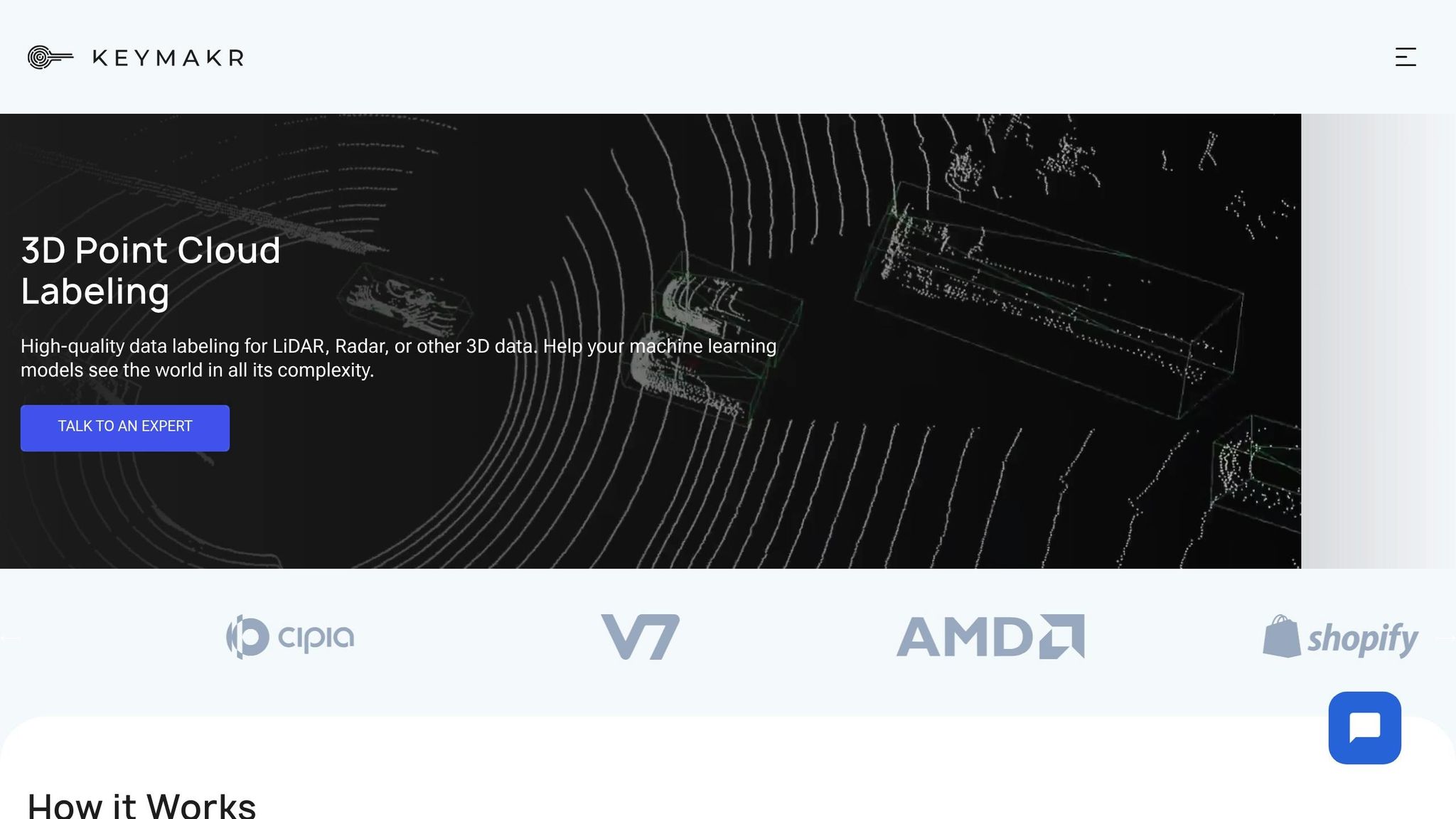
3D Point Cloud Annotation process by Keymakr on Keylabs annotation platform
Leading 3D Point Cloud Annotation Service Providers
When selecting a 3D point cloud annotation partner, it's essential to align your choice with your data type, project volume, and accuracy requirements. Each provider brings a unique approach, balancing cost, quality, and speed. Below is an overview of four providers, highlighting their strengths and ideal use cases.
Anolytics offers a budget-friendly solution for teams working with LiDAR, RADAR, and photogrammetry data. Their expertise in autonomous navigation and Earth surface mapping ensures 99% accuracy, with object detection precision down to 1 cm (about 0.4 inches). This makes them an excellent choice for projects like infrastructure development, disaster management, and agriculture. By utilizing an offshore workforce model, Anolytics keeps costs low while adhering to SOC 2 Type 1 security standards.
Cogito Tech specializes in photogrammetry, which involves tagging 3D point clouds using overlapping 2D images. This method is particularly useful for geospatial modeling, remote sensing, and analyzing elevation or slopes. Their "pay-as-you-avail" pricing model allows for flexibility in scaling large projects. Cogito Tech's ability to convert 3D points into matching 2D pixels makes them ideal for applications in agritech, defense, and geospatial modeling.
Sama focuses on sensor fusion and ground truth annotation for enterprise clients, processing over 10 billion points per month with a 99% first-batch client acceptance rate. Their platform integrates 3D point clouds with video data, utilizing automatic ground detection to remove visual noise and "Fixed World" coordinate conversion for accurate sensor pose mapping. Trusted by 40% of FAANG companies, Sama boasts a 92% Customer Satisfaction (CSAT) score and a Net Promoter Score (NPS) of 64 in 2024. Their managed global workforce ensures consistent service levels for safety-critical projects.
Keymakr stands out in LiDAR camera annotation, leveraging AI-based classification for precision-heavy applications like smart cities and self-driving technologies. Their expertise in LiDAR camera 3D modeling has earned them a 4.8/5 Clutch rating. Keymakr is a top choice for robotics and healthcare projects, where accuracy is paramount for safety-critical systems.
Provider Comparison Table
| Provider | Specialization | Primary Data Types | Key Strength | Best For |
|---|---|---|---|---|
| Anolytics | Autonomous Navigation | LiDAR, RADAR, Photogrammetry | 1 cm object detection precision | Infrastructure, disaster management, agriculture |
| Cogito Tech | Geospatial & Agritech | LiDAR, RADAR, Photogrammetry | 2D-to-3D photogrammetry tagging | Remote sensing, defense, geospatial modeling |
| Sama | Ground Truth for Enterprise | LiDAR, RADAR, Sensor Fusion | 10B points/month, 99% acceptance rate | High-volume enterprise AI production |
| Keymakr | Smart Cities & Precision CV | LiDAR Cameras | AI-based point cloud classification | Robotics, smart cities, healthcare AI |
For complex projects, it's wise to pilot the most challenging sequences first to identify potential issues like sequence drift or export errors. For high-stakes tasks such as autonomous driving, prioritize providers with multi-stage consensus reviews and detailed audit trails. Additionally, ensure your chosen provider can handle multi-LiDAR setups and maintain time-synchronized projections to avoid inconsistencies across data sets.
These insights set the stage for exploring how automation and human review can further refine annotation quality.
sbb-itb-cdb339c
Automation and Quality Control Trends
The 3D annotation industry is moving away from manual methods and embracing AI-assisted platforms. These tools take care of repetitive tasks, allowing humans to focus on edge cases. This shift is addressing a major bottleneck - manual 3D point cloud annotation is notoriously time-consuming. As Karyna Naminas, CEO of Label Your Data, explains:
Annotation errors can degrade performance by over 25%
This highlights why quality control is just as crucial as speed. With these workflow changes in mind, let’s explore the automation tools that are streamlining 3D annotation.
How Automation Affects 3D Annotation
Modern automation tools are designed to handle the most tedious parts of 3D annotation. Features like AI-assisted object fitting, such as "Snapping" or "Autofit", allow annotators to place a rough cuboid, which the system then adjusts to fit the object’s points precisely. Temporal propagation tools track objects across multiple frames, reducing the need to label each frame manually while keeping object IDs consistent.
Another game-changer is automated ground segmentation. Algorithms like Patchwork++ can identify and annotate ground surfaces with a single click, making it easier to filter out irrelevant points. Additionally, sensor fusion synchronization links 2D images with 3D point clouds in real-time. For example, annotating an object in a 2D camera view can automatically generate a corresponding 3D cuboid, which is particularly useful in areas where point cloud data is sparse. These advancements have significantly sped up workflows - professional platforms can now pre-process around 200 point cloud frames in just 5 minutes.
Combining Automation with Human Review
While automation dramatically speeds up routine tasks, human review remains indispensable, especially in safety-critical applications. For instance, in 2025, LiDAR manufacturer Ouster teamed up with Label Your Data to enhance their machine learning pipeline. They utilized 10 specialized annotators who combined 2D bounding boxes and 3D cuboids with automated tracking. This collaboration led to a 20% boost in product performance, a 0.95 F1 score, and a 15% improvement in tracking accuracy.
The success of this hybrid approach lies in dividing tasks strategically. Automation takes care of ground segmentation and temporal tracking, while humans refine AI-generated annotations, resolve occlusions, and address complex spatial details. For production-grade datasets, particularly in autonomous driving, a multi-level review process is essential. After all, annotation quality can directly impact passenger safety.
Choosing the Right 3D Annotation Service Provider
When selecting a 3D annotation provider, it's essential to align their capabilities with your project's technical requirements. Opting for the cheapest option can lead to hidden costs, including quality issues, high annotator turnover, and extra post-processing work.
Matching Providers to Project Needs
Start by defining your delivery model. If your project has stable guidelines, a vendor-managed workforce might be the best fit. For evolving, long-term projects, consider embedded teams that integrate with your workflows. For example, 1840 & Company offers a monthly full-time equivalent (FTE) model without upfront sourcing fees, allowing annotators to seamlessly join your internal processes.
It's crucial to ensure your provider supports the sensor types your project relies on - whether that's LiDAR, RADAR, photogrammetry, or sensor fusion. For instance, Cogito Tech and Anolytics specialize in RADAR and photogrammetry, while Segments.ai is tailored for robotics applications requiring synchronized 2D and 3D data.
Before committing to a provider, run a free pilot to check compatibility with your tools, point cloud density, and export formats like LAS/LAZ, KITTI, or custom JSON. Quality assurance (QA) processes also play a key role. Top providers use multi-stage reviews, inter-annotator agreement, and IoU thresholds to ensure high-quality results. While achieving 97%+ accuracy may cost more, it’s critical for applications like autonomous driving, where even minor annotation errors can reduce model performance by over 25%. Basic quality levels (90–93% accuracy) often cost 15–25% less but may not meet the demands of safety-critical tasks.
Domain expertise is another factor to consider. For example, annotating medical imaging requires certified professionals, which can cost significantly more - ranging from $50 to $100 per hour for radiology-level experts. As Kyle Hamilton, a PhD Researcher at TU Dublin, shared about Label Your Data:
Label Your Data were genuinely interested in the success of my project, asked good questions, and were flexible in working in my proprietary software environment.
By aligning your provider with these technical and operational needs, you can ensure reliable model performance. Once you’ve identified your requirements, platforms like Data Annotation Companies can make finding the right provider easier.
Finding Providers Through Data Annotation Companies

The Data Annotation Companies platform (https://dataannotationcompanies.com) allows you to evaluate 3D annotation providers based on delivery models, sensor compatibility, QA processes, and industry expertise.
It explains the difference between "Output Vendors", who deliver labeled data with minimal oversight, and "Embedded Teams", where annotators work directly within your workflows. This distinction is important because low per-image rates can sometimes lead to hidden costs from rework, annotator turnover, or format adjustments. For projects exceeding 100,000 labels, volume discounts are often available.
The platform also highlights providers with niche expertise. For example, Keymakr excels in high-precision robotics and healthcare projects (4.8/5 on Clutch), while Sama specializes in high-volume enterprise pipelines (4.6/5 on G2). Additionally, it identifies providers with key security certifications, such as ISO 27001, SOC 2, HIPAA, or GDPR, which are vital when handling sensitive data in industries like healthcare and fintech.
Conclusion
Choosing the right 3D point cloud annotation provider requires a careful balance between cost, quality, and technical compatibility. With the global data annotation market expected to surpass $2.26 billion by 2025, growing at a 32.5% CAGR, the demand for precise spatial data in autonomous vehicles, robotics, and AI applications continues to rise.
Each provider discussed in this article brings distinct strengths to the table. Anolytics offers an impressive 99% accuracy rate. Sama stands out for managing high-volume enterprise projects. Keymakr is tailored for projects where precision is paramount, while Cogito Tech specializes in advanced 3D annotation solutions. These differences underscore the importance of aligning your choice with your project's unique needs.
When considering total costs, it’s essential to look beyond base rates. Offshore centers in locations like Vietnam, India, or Egypt may reduce expenses by up to 70%, but hidden costs - such as rework, annotator turnover, or licensing fees - can offset these savings. Investing in high-quality annotation (97%+ accuracy) may cost more initially but prevents costly issues like model retraining, which is particularly crucial for safety-critical applications.
To ensure a provider meets your expectations, run a proof-of-concept project with 1,000–2,000 samples. This helps evaluate accuracy, turnaround time, and compatibility with your data. Setting clear IoU thresholds and quality metrics upfront is vital to avoid label inflation and maintain consistency.
Ultimately, high-quality annotation reduces model retraining costs and ensures safety in critical systems. Taking the time to evaluate providers at every stage helps avoid expensive mistakes and ensures your project achieves optimal performance. For a streamlined selection process, platforms like Data Annotation Companies compare delivery models, security certifications (ISO 27001, SOC 2, HIPAA), and domain-specific expertise to help you find the perfect fit.
FAQs
Which 3D annotation type should I use for my use case?
When it comes to selecting the right 3D annotation type, it all boils down to your specific use case and the kind of data you're working with. For instance, 3D cuboids are ideal for tasks like identifying vehicles in autonomous driving scenarios. On the other hand, segmentation is more suited for detail-oriented projects such as urban mapping or analyzing vegetation. The choice should align with your project’s objectives - whether it’s about object detection, segmentation, or classification - and the complexity of your 3D point cloud data.
How can I verify 3D label quality before scaling up?
To ensure the quality of 3D labels before scaling, it's essential to use methods like label verification and adjustment. Tools that incorporate human review capabilities allow workers to double-check or refine 3D annotations, improving accuracy. Alongside this, having clear guidelines, leveraging AI-supported tools, and conducting regular quality checks can help uphold high standards. These practices minimize mistakes and ensure dependable labels before you grow your dataset.
What factors drive 3D point cloud annotation cost and turnaround time?
The cost and turnaround time for 3D point cloud annotation hinge on several factors, including the size of the dataset, the complexity of the annotations, and the level of quality required. Larger datasets naturally take more time and resources, while intricate annotations can drive up both the price and the time needed for completion.
Other key elements include the expertise of the annotators, the efficiency of the workflow, and the use of specialized tools. The type of service model - whether it's a one-time project or an ongoing arrangement - also plays a role. Higher quality standards often demand additional time and effort, impacting overall timelines and costs.