Best Practices for Labeling Conversational AI Data
· Data Annotation
Practical guidelines for labeling conversational AI: define objectives, write clear annotation rules, ensure diverse data, train annotators, and use quality checks with HITL.
Best Practices for Labeling Conversational AI Data
Labeling data for conversational AI is what makes your chatbot or voice assistant actually understand user requests. Without accurate labels, even the smartest AI models fail to deliver reliable responses. Here's the key takeaway: your AI is only as effective as the data you train it on.
Key Insights:
- Why Labeling Matters: Properly labeled data ensures the AI can interpret user intents (like "cancel subscription") and entities (like dates or locations) accurately. For example, refining labeled data boosted Google's model performance from an F1 score of 50 to 69.
- Guidelines Are Crucial: Clear, detailed annotation rules prevent errors and inconsistencies. Include examples, counterexamples, and FAQs to keep your labeling team aligned.
- Diversity in Data: Training data must reflect a variety of accents, demographics, and linguistic styles to avoid bias and improve performance for all users.
- Multiple Annotators Improve Quality: Using multiple reviewers and quality checks (like benchmarks and consensus workflows) ensures consistent, reliable results.
- Human-in-the-Loop (HITL): For complex or nuanced cases, human oversight is essential to improve accuracy and handle edge cases effectively.
Quick Overview:
- Define Objectives: Clarify what you’re labeling and why (e.g., training a banking chatbot to detect fraud).
- Document Guidelines: Create precise rules with examples to avoid ambiguity.
- Ensure Diversity: Use varied data sources to represent different accents, slang, and demographics.
- Train Annotators: Teach them to handle conversational context, tone shifts, and domain-specific terms.
- Monitor Quality: Use tools like inter-annotator agreement (IAA) and gold sets to maintain high standards.
- Use HITL Systems: Combine automation with human expertise for nuanced tasks.
By following these steps, you’ll set your AI up for success, reduce errors, and create a more seamless user experience. Let’s break down the details.
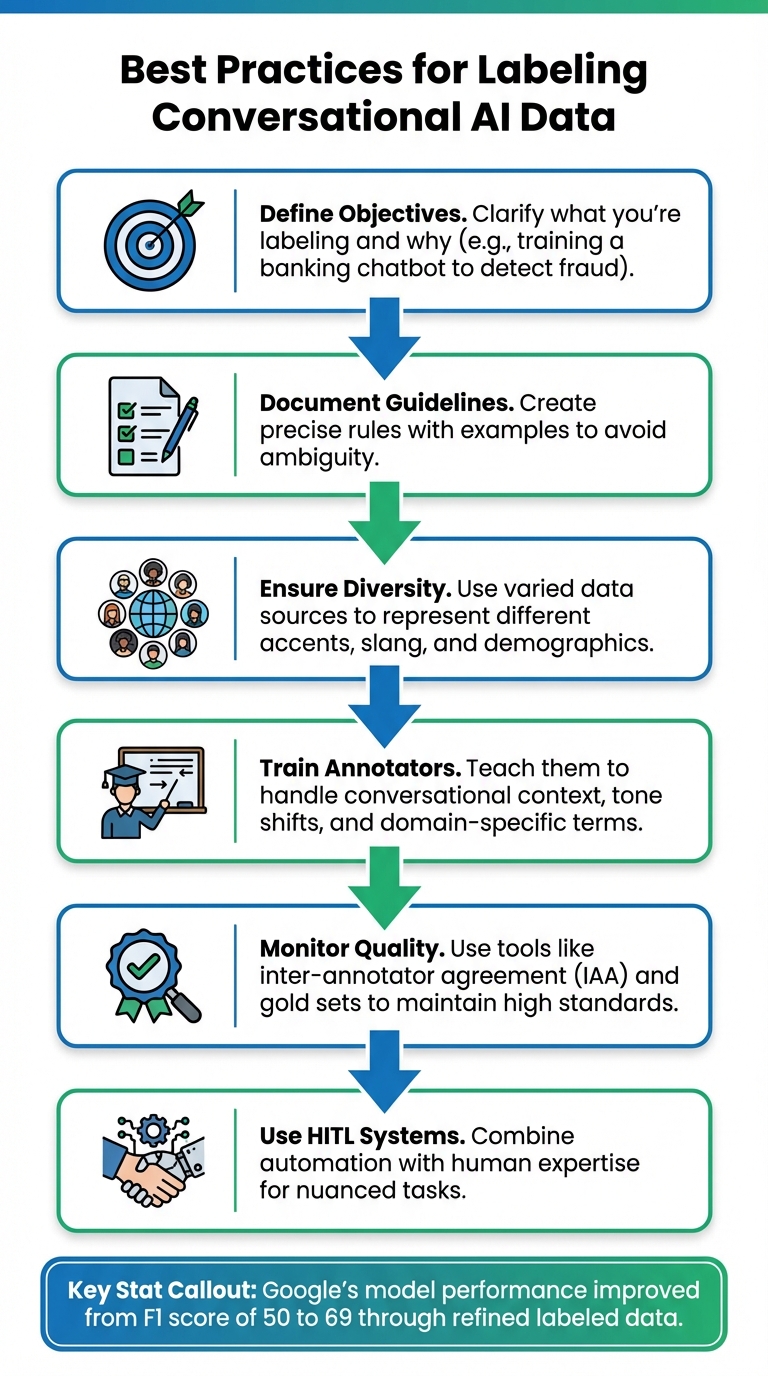
6-Step Process for Labeling Conversational AI Data
Data Labeling Best Practices // Charles Brecque // AI in Production Conference Lightning Talk
Create Clear Annotation Guidelines
Clear guidelines are the backbone of any successful labeling project. When these are absent, annotators tend to rely on their own interpretations, which leads to inconsistencies. Cassie Kozyrkov, Chief Decision Scientist at Google, puts it succinctly:
Newsflash: Ground truth isn't true. It's an ideal expected result according to the people in charge.
In other words, your guidelines need to define what "correct" means for your specific project. The difference between vague and precise instructions is massive. Ambiguous rules can lead to missing key attributes or incorrect labels, while detailed instructions - like specifying to "exclude the sidewalk" - can achieve near-perfect accuracy.
Once you’ve established clear guidelines, the next step is to determine your labeling objectives.
Define Labeling Objectives
Before diving into annotation rules, clarify your end goal. Are you training a chatbot to differentiate between complaints and compliments? Or are you creating a voice assistant to extract dates and locations from travel-related queries? Your objectives will shape the label space, which includes all the categories annotators will use. Without well-defined goals, you risk overlooking critical categories. Running a pilot batch early can help identify any gaps.
It’s also essential to provide annotators with the context of the project. Don’t just tell them what to label - explain why it matters. For instance, if they know they’re helping train a banking chatbot to identify fraud reports or a retail assistant to handle returns, they’ll be better equipped to handle tricky edge cases with more informed judgment.
Document Guidelines
After defining your objectives, compile them into a detailed guide. Each category should have a clear definition, paired with examples and counterexamples to avoid confusion. For instance, if annotating location entities, specify whether "New York" refers to the city, the state, or both, and explain how to handle ambiguous mentions.
Look to examples like the Penn Treebank Project, which created Part-of-Speech tagging guidelines. They included a dedicated section for "Problematic Cases" to address common disagreements, such as differentiating between prepositions and particles. For more complex tasks, flowcharts can be particularly helpful. Researchers have used them to guide annotators through multi-step decisions, such as labeling argument types in Presidential debates.
Consistency is key: the same entity must always receive the same label across all annotations, whether in training or testing sets. For subjective tasks like toxicity detection, a detailed rubric can help reduce personal bias. Additionally, maintaining an FAQ document for ad-hoc decisions and clarifications, along with version control to track updates, can ensure everyone stays aligned.
Guidelines should evolve as your project grows. Feedback loops are invaluable for refining rules when new ambiguities arise. This iterative approach ensures your documentation remains effective as your dataset scales from a few hundred to tens of thousands of examples. Well-documented, consistent rules are the foundation for maintaining both quality and diversity as your annotation efforts expand.
Maintain Consistency and Quality Across Annotations
Clear annotation guidelines are a great starting point, but they’re not enough on their own. To ensure consistent and high-quality labeling, active oversight is critical. Without it, your chatbot might correctly identify a complaint in one conversation but miss a similar one in another, leading to unreliable performance.
Language ambiguity often complicates labeling. A single user message might carry mixed sentiments or multiple intents, leaving room for interpretation. Personal bias can further influence how annotators handle these gray areas. To address this, systematic checks are essential for catching discrepancies early and ensuring a unified approach.
Use Multiple Annotators
Having multiple annotators review the same conversation can reduce bias and improve accuracy. For example, assigning three people to independently label the same data allows you to identify areas where the guidelines might need refinement. This is especially useful for tasks that involve subjective judgment.
To handle disagreements systematically, consensus workflows come into play. For simpler tasks, majority voting works well - if two out of three annotators label a message as a "complaint", that becomes the final label. For more complex or sensitive data, weighted voting can be used, where experienced annotators or domain experts have greater influence on the final decision. Alternatively, adjudication involves a senior expert stepping in to resolve disagreements.
Before scaling up, calibration sessions can be invaluable. In these sessions, annotators label a small pilot batch together, discuss their differences, and adjust the guidelines based on what they learn. This step ensures everyone is aligned before tackling larger datasets, reducing the risk of systematic errors. These strategies also set the stage for real-time quality monitoring, which is discussed next.
Implement Quality Checks
Even with multiple annotators, quality checks are essential to maintain data integrity. Waiting until the end of a project to verify quality can be risky. Instead, implement real-time quality monitoring to catch and address issues as they arise.
One effective method is to insert benchmark tasks (gold sets) into the labeling queue. These tasks are pre-labeled and can help measure annotator accuracy. If someone consistently misses these benchmarks, it may be time for retraining - or even removal.
Metrics like Inter-Annotator Agreement (IAA) are also useful for assessing team alignment. Values like Cohen's Kappa or Fleiss' Kappa above 0.6 indicate "substantial agreement", while values above 0.8 show "almost perfect agreement". However, as Grammarly Engineering points out:
High IAA means annotators understand the guidelines and are aligned on how to apply the guidelines to the data, but it doesn't mean that the data itself is high quality.
This highlights the importance of ensuring that consensus aligns with your project’s goals.
Adding a hierarchical review layer - where senior annotators or domain experts audit a portion of the labeled data - can further enhance quality. Random manual audits can also uncover trends in errors that automated checks might miss. For instance, if annotators often confuse a "refund request" with an "order cancellation", updating the guidelines with clearer examples can help.
| Resolution Strategy | Description | Use Case |
|---|---|---|
| Majority Voting | Select the label with the majority vote. | Ideal for straightforward tasks with clear categories. |
| Adjudication | A senior expert reviews disagreements and makes the final decision. | Best for complex or high-stakes data. |
| Collaborative Resolution | Annotators discuss disagreements to reach a shared understanding. | Useful in early stages to refine guidelines. |
| Weighted Voting | Votes are weighted based on annotator expertise or accuracy history. | Suitable for large-scale projects with mixed experience levels. |
It’s also crucial to have an escalation process in place for ambiguous cases. Instead of guessing, annotators should flag such cases for expert review. To maintain accountability, use version control to document label assignments - this can be a lifesaver when debugging model issues later. For sensitive data, such as in healthcare or finance, manual labeling by in-house teams or secure on-premises systems is often a safer choice than crowdsourcing.
Collect Diverse and Representative Data
Even with perfectly labeled data, a model’s success relies heavily on the variety and representativeness of its training data. If your dataset is sourced from a single demographic or region, your model may falter when faced with real-world users who speak differently. Gathering natural, unscripted conversations from a range of sources is far more effective than relying on artificially generated or overly scripted data.
Choosing poor data at the start of the pipeline can lead to issues that persist throughout the model's lifecycle. As Appen highlights:
Human speech is natural and unscripted; we often use filler words that are irrelevant to our intent... Humans also have a high variability of phrasing, depending on their location, upbringing, and experience.
Consider the scope of modern voice assistants: Google Assistant supports over 40 languages, and Apple’s Siri handles 35. Even within a single language, differences in accents, dialects, and regional expressions create significant variation. This makes it crucial for training data to reflect the diversity of real-world language use.
Prioritize Diversity in Conversations
Just as clear guidelines help annotators, diverse linguistic data helps models understand a wide range of users. Linguistic and demographic diversity directly influences how well a model performs. If your chatbot is intended for users of varying ages, regions, and backgrounds, your training data must mirror that complexity. For instance, achieving fairness in speech recognition may require dedicating 50% of the dataset to non-native speakers, even if they represent a smaller portion of the user base. This approach, often called oversampling for parity, ensures the model works equally well for everyone.
Training a model on one regional language variant can lead to misunderstandings when faced with phrases from other regions. Ignoring these differences early on can create errors that persist throughout the model’s lifecycle. As Google PAIR explains:
If examples used to train the run recommendation algorithm only come from elite runners, then they would likely not be useful in creating an effective model to make predictions for a wider user base.
A diverse labeling team is just as crucial as diverse data. When labelers share the same cultural and demographic backgrounds as your end users, they’re better equipped to catch subtle nuances - like regional variations in units or formats - that could otherwise introduce bias.
When natural data is limited, data augmentation techniques can help bridge the gaps. Adjusting pitch, speed, or adding background noise can prepare models for different speaking styles and real-world conditions. However, augmentation should complement - not replace - authentic diversity in your dataset. Tools like Facets or the What-If Tool can help visualize your dataset and identify underrepresented groups.
Balance Data Across Intents and Entities
Balancing your dataset isn’t just about diversity - it’s also about ensuring that all intents and entities are properly represented. Intent imbalance is a common issue in conversational AI. For example, if 80% of your dataset focuses on "check order status" while only 5% covers "request refund", the model may become biased toward the overrepresented intent, leading to misclassifications. To prevent this, aim for at least 25 examples per intent and downsample overrepresented intents to maintain balance.
Entity consistency is another key factor. Every instance of an entity should be labeled consistently across both training and testing data. When entities play multiple roles in a conversation, use contextual signals to help the model differentiate between them. For instance, in a travel booking scenario, "from New York" and "to Boston" both involve cities, but the context ("from" vs. "to") indicates whether the city is the origin or destination.
It’s also wise to include out-of-scope data intentionally. Training your model on queries it’s not designed to handle allows it to recognize when a user’s request falls outside its capabilities, reducing the risk of overconfidence in unfamiliar situations.
| Diversity Factor | Impact on Model | Mitigation Strategy |
|---|---|---|
| Accents/Dialects | Higher error rates for non-standard speakers | Custom audio collection from specific regions |
| Demographics | Skewed predictions | Oversample underrepresented groups |
| Linguistic Style | Difficulty recognizing casual or slang speech | Collect in-situ data from real conversations |
| Cultural Context | Misinterpretation of units or formats | Use diverse labeler pools matching end-user profiles |
Lastly, don’t overlook linguistic variations such as casing, punctuation, and diacritics. These small details can lead to unintended patterns in the model if not handled correctly. Instead of relying solely on spellcheckers, include common user misspellings in your training data to help the model recover from them. Enable settings like "normalize casing" and "data augmentation for diacritics" to make your model more resilient to minor grammatical or stylistic changes.
sbb-itb-cdb339c
Train Annotators for Conversational Contexts
Clear guidelines are essential, but they’re just the starting point. To truly capture the nuances of conversational AI, annotator training is critical. Conversations are dynamic - intent can shift mid-sentence, tones can swing from calm to frustrated, and the same word might mean different things depending on the context. Without specialized training, these subtleties can be missed, leading to errors that ripple through the system.
The stakes are high. Poor-quality data can have serious consequences; for instance, 54% of Americans worry about AI in healthcare because of the risk of false diagnoses. High-quality annotations, paired with well-trained annotators, are the foundation for reducing such risks.
Teach Contextual Understanding
To annotate conversational data effectively, annotators need to grasp how dialogue flows and how intent evolves. Conversations are rarely static. For example, a customer might start by asking about store hours, then pivot to a refund request, and later inquire about shipping policies. Tracking this progression is key.
Understanding speaker roles is equally important. Annotators must distinguish between agents and customers, not just by identifying who is speaking but by recognizing the dynamics at play - such as differences in formality, tone, or authority - and how these shift throughout the exchange.
Linguistic cues also play a big role. In travel booking, for instance, the word “from” often signals an origin city, while “to” points to a destination. Annotators need to pick up on these patterns, as well as details like capitalization, punctuation, and diacritics. For example, a message written in all caps might signal urgency or anger, while the absence of punctuation could suggest a casual tone.
When working in specialized fields like healthcare, legal, or financial services, domain expertise becomes invaluable. Annotators familiar with these areas can better handle technical jargon and sensitive data. For example, in a medical context, “SOB” refers to “shortness of breath,” not an insult. This level of understanding is critical for accurate and effective annotations.
Provide Regular Feedback and Iteration
Training annotators isn’t a one-and-done process - it requires continuous refinement. As Snorkel AI points out, annotation guidelines evolve over time, with pilot projects often revealing gaps that need to be addressed.
Start small with pilot datasets to test and tweak your guidelines before scaling up. Assign the same samples to multiple annotators to identify discrepancies, which can then be used as teaching moments. This approach helps refine both the guidelines and the annotators’ understanding.
A closed-loop feedback system is essential for tracking errors and addressing them in real-time. Be mindful of annotator fatigue, especially in high-volume projects. Signs like slower labeling times, increased disagreements, or higher rejection rates could indicate burnout. Regular training sessions can help annotators stay sharp and prepare them for new or unexpected edge cases.
Iteration pays off. For instance, a banking chatbot project using Google’s PaLM saw its F1 score jump from 50 to 69 through focused iterations and continuous feedback. These improvements underscore the importance of investing in ongoing training and feedback to enhance performance.
Use Human-in-the-Loop for Complex Dialogues
Integrating human oversight into AI systems ensures that complex and ambiguous cases are handled with the care they require. Even with skilled annotators and well-defined guidelines, some conversations are simply too nuanced for automation alone. That’s where human-in-the-loop (HITL) systems shine - they blend the speed and efficiency of automation with the insight and judgment that only humans can provide.
Gartner has estimated that by 2025, 30% of new legal tech automation tools will include HITL solutions. Meta, for example, used 10 million human-annotated examples to train its Llama 3 model. IBM summarizes the value of this approach perfectly:
The goal of HITL is to allow AI systems to achieve the efficiency of automation without sacrificing the precision, nuance and ethical reasoning of human oversight.
When to Use HITL
Not every interaction or task needs human intervention - it’s neither practical nor cost-effective. Instead, HITL should be applied strategically in specific situations where human expertise adds the most value:
- Low-confidence predictions: If a model’s confidence score falls below a certain threshold (usually 70–80%), those cases should be routed to human reviewers to avoid errors from slipping through.
- Subjective or nuanced tasks: Tasks like sentiment analysis, sarcasm detection, or interpreting creative language often require human judgment because of their inherent complexity.
- Specialized domains: In areas such as legal, medical, or technical fields, human reviewers with domain expertise can better handle the subtle distinctions and specialized language (e.g., distinguishing clinical abbreviations from casual terms in medical discussions).
- Unfamiliar or outlier scenarios: When models encounter new or unusual data patterns, human oversight is essential to interpret these cases and set labeling precedents for future use.
This targeted application of HITL ensures that human judgment complements automation, rather than duplicating efforts unnecessarily.
Benefits of a Collaborative Model
The real strength of HITL lies in its ability to improve AI systems over time. By combining automated tools with human expertise, you create a feedback loop that enhances both accuracy and efficiency. Automated processes handle straightforward, high-confidence cases, while humans focus on the more challenging or ambiguous ones. As Scale AI explains:
The combination of automated labeling plus human in the loop consistently outperforms either approach on its own.
HITL also supports active learning by flagging the most uncertain or informative samples for human review, which helps refine the model further. Beyond improving performance, this approach also plays a key role in addressing bias and increasing transparency. Human reviewers can identify and correct social biases that automated systems might inadvertently amplify, which helps build trust and credibility.
Considering that data organization and labeling can consume up to 80% of an AI project’s time, using human expertise for critical tasks is far more cost-efficient than relying solely on high-paid data scientists, whose salaries can reach as much as $190,000 per year. HITL systems strike the perfect balance between efficiency and precision, making them an essential tool for tackling complex AI challenges.
Conclusion
Summary of Best Practices
The performance of your conversational AI model is directly tied to the quality of its training data. To set your project up for success, start by crafting clear annotation guidelines that define intents and entities with precision. Focus on maintaining high standards of data quality, consistency, and diversity - these are the cornerstones of a reliable system. Equip annotators with the necessary context, and use human-in-the-loop systems to refine and improve performance over time. By adopting this collaborative method, you can elevate your AI from functional to outstanding.
These practices create a solid foundation for building effective AI systems. From here, it’s all about putting these strategies into action.
Next Steps for Professionals
Before scaling up, test your guidelines through pilot projects to uncover any gaps. Establish a robust schema, implement quality control measures, and choose the right workforce model - whether that’s an in-house team, a crowdsourced solution, or specialized partners.
For those seeking expert assistance, Data Annotation Companies provides a directory of trusted service providers. These partners bring domain expertise and technical certifications to the table, helping you achieve faster, more accurate results while keeping costs in check and maintaining top-tier quality.
FAQs
How can I reduce bias in my conversational AI model?
To reduce bias in your conversational AI model, start by incorporating a diverse training dataset. This means including language patterns from a wide range of ages, genders, ethnicities, dialects, and socioeconomic backgrounds. A well-rounded dataset helps the model better reflect the variety of human experiences and communication styles. Clear labeling guidelines are also key - make sure these explicitly address bias, and train annotators to follow them closely. Using a diverse group of annotators and rotating their tasks can further ensure no single perspective dominates the data.
It’s also important to regularly audit your labeled data. Look for potential biases, such as uneven error rates across different demographic groups, and address them promptly. Tools like consensus scoring or model-assisted labeling can be helpful for spotting low-confidence or potentially biased examples that need extra attention. When designing your conversational schema, aim for neutrality and consistency - avoid embedding assumptions about gender, race, or ability into the phrasing of queries.
Lastly, think about collaborating with a professional data annotation provider that emphasizes unbiased labeling and rigorous quality checks. By combining diverse data, transparent processes, and continuous monitoring, you can build an AI model that feels fair and inclusive for everyone.
How can I ensure high-quality data annotations for conversational AI?
To ensure high-quality data annotations, start by developing clear, detailed guidelines. These should outline labeling rules, address potential edge cases, and establish formatting standards. Running a pilot annotation round can help spot ambiguities and fine-tune your instructions. It's also crucial to train annotators thoroughly, ensuring they grasp both the guidelines and the overall project objectives.
Implement quality control measures like consensus scoring or duplicate labeling, where multiple annotators review the same data. Any disagreements can be resolved by a senior reviewer or subject matter expert. Continuously monitor performance, flag items with low confidence for further review, and adjust the guidelines as necessary.
You can also leverage model-assisted labeling for simpler tasks, freeing up annotators to concentrate on more complex cases. Regular audits, calculating inter-annotator agreement, and comparing results to benchmarks can help maintain consistency. Providing timely feedback and keeping a versioned log of guideline updates will further ensure long-term accuracy and quality.
When should you use human-in-the-loop systems for conversational AI projects?
Human-in-the-loop (HITL) systems shine when AI models need human expertise to tackle tricky or nuanced tasks. In the world of conversational AI, HITL proves especially useful in these three scenarios:
- Unclear or low-confidence inputs: When the AI stumbles upon ambiguous phrases, slang, or unfamiliar terms, human reviewers step in to provide accurate labels, sharpening the model's ability to interpret such inputs.
- High-stakes or rare cases: In critical fields like healthcare, finance, or customer support, human oversight ensures decisions are both accurate and ethically sound, especially in sensitive or uncommon situations.
- Model improvement over time: During training, humans label key data samples that the model identifies, enabling better performance while keeping costs manageable.
By weaving HITL into your workflow, you can achieve more accurate data, minimize errors, and create conversational AI systems you can count on. For specialized support, Data Annotation Companies offers a curated list of experts to help you implement these practices effectively.