Checklist for HIPAA-Compliant Data Annotation Services
· Data Annotation
HIPAA checklist for data annotation: staff training, BAAs, risk analysis, encryption, access controls, breach response, vendor compliance, de-identification.
Checklist for HIPAA-Compliant Data Annotation Services
If you're handling Protected Health Information (PHI) for tasks like labeling medical data or annotating health records, HIPAA compliance is non-negotiable. Non-compliance can result in steep fines, legal consequences, and operational disruptions. Here's a quick guide to staying compliant:
- Train Your Team: All staff interacting with PHI must complete HIPAA training, covering privacy rules, security threats like ransomware, and breach protocols.
- Sign Business Associate Agreements (BAAs): Ensure every vendor or subcontractor handling PHI has a signed BAA outlining their responsibilities.
- Conduct Risk Assessments: Identify where PHI is stored, assess vulnerabilities, and document mitigation strategies.
- Encrypt Data: Use FIPS-validated encryption for storing and transmitting PHI to prevent unauthorized access.
- Control Access: Implement role-based access and multi-factor authentication to limit PHI exposure.
- Prepare for Breaches: Develop a breach response plan, test it regularly, and ensure timely notification of affected parties if a breach occurs.
- Work with Compliant Vendors: Evaluate vendor security standards and ensure they meet HIPAA requirements.
These steps form the foundation for safeguarding PHI, reducing risks, and maintaining compliance over time. The article dives deeper into administrative, technical, and physical safeguards, as well as breach response and vendor management strategies.
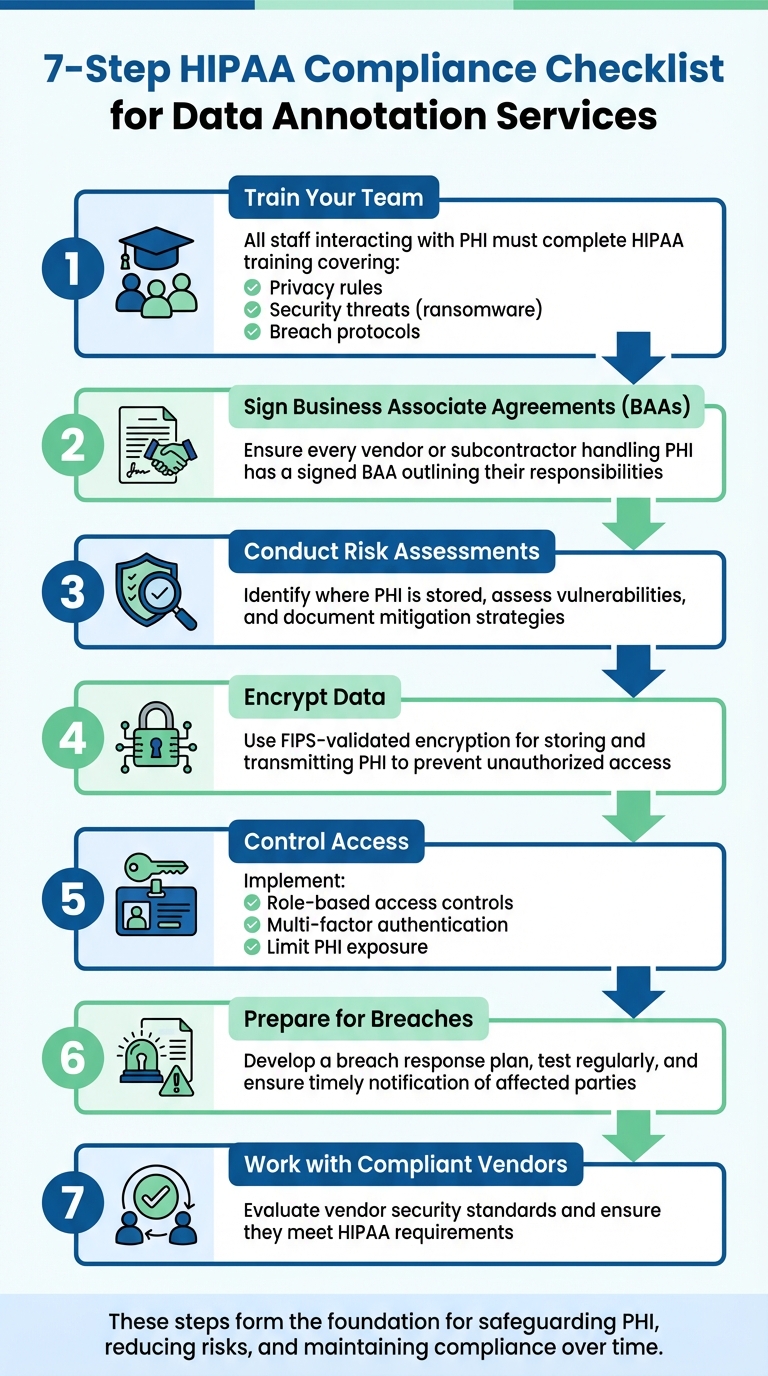
7-Step HIPAA Compliance Checklist for Data Annotation Services
Human-in-the-Loop De-Identification Workflows in the Generative AI Lab
Administrative Requirements for HIPAA Compliance
Administrative safeguards are at the heart of any HIPAA compliance program. These safeguards include the policies, procedures, and documentation that dictate how your organization manages Protected Health Information (PHI) daily. They ensure that PHI is handled properly and that your organization stays compliant with regulations.
Staff Training and Education Programs
Anyone who deals with PHI - whether employees, contractors, students, or volunteers - must undergo formal HIPAA training. While the training program should be tailored to your organization's needs, it must thoroughly cover the Privacy, Security, and Breach Notification Rules.
Your training should also address current risks, such as social engineering, ransomware, and improper mobile device use. To stay ahead, update the training regularly to reflect new threats. Keep detailed records of each session and track annual completion rates to ensure you're prepared for audits.
Accountability is key. Establish clear sanction policies that outline consequences for HIPAA violations, ranging from minor mistakes to major breaches. For resources, the federal government offers helpful materials like CMS's "HIPAA Basics for Providers" and security guides from HealthIT.gov.
Business Associate Agreements (BAAs)
If you work with vendors or subcontractors who handle PHI, you are legally required to have a signed Business Associate Agreement (BAA) in place before they access any data. This is non-negotiable, and failing to comply can lead to severe penalties.
For example, in 2018, Advanced Care Hospitalists paid $500,000 after the Office for Civil Rights (OCR) discovered they had shared PHI with a third-party billing company for over two years without a signed BAA.
"A business associate is directly liable under the HIPAA Rules and subject to civil and, in some cases, criminal penalties for making uses and disclosures of protected health information that are not authorized by its contract or required by law." - HHS.gov
Each BAA must include specific elements, such as permitted uses of PHI, required safeguards, subcontractor responsibilities, breach reporting protocols, and termination procedures. If you're using cloud-based tools like Google Workspace or AWS, confirm that the services you use are "in-scope" under the provider's standard BAA. Before signing, request the vendor's most recent risk assessment and breach response plans. It's also a good practice to review your BAAs annually to ensure they align with current federal and state privacy laws.
Risk Assessments and Policy Records
Conducting a risk analysis is a mandatory first step in HIPAA compliance. This involves identifying all locations where electronic PHI resides - such as hard drives, portable devices, cloud platforms, and networks. You must document potential threats and pinpoint vulnerabilities in your systems and policies.
"Risk analysis is the first step in identifying and implementing safeguards that comply with and carry out the standards and implementation specifications in the Security Rule." - HHS Office for Civil Rights
The NIST Special Publication 800-30 framework is widely recognized as the standard for conducting these assessments. It evaluates risk based on two factors: likelihood (how probable is the threat?) and impact (how damaging would it be?). While HIPAA doesn't mandate a specific format for documentation, you are required to maintain written records of your analysis and use them to guide your risk management efforts.
Reassess risks whenever significant changes occur in your operations - such as adopting new technology, introducing new workflows, or experiencing major staff changes. These administrative steps lay the groundwork for the technical and physical safeguards needed to protect PHI effectively.
Data Management and Classification
After setting up your administrative safeguards, the next step is ensuring that Protected Health Information (PHI) is properly identified, organized, and tracked throughout your data annotation workflows. This process involves more than just recognizing what qualifies as PHI - it requires documenting where it resides, how it moves, and who interacts with it at every stage.
Mapping PHI Touchpoints
To manage PHI effectively, start by defining it according to HIPAA's 18 Safe Harbor identifiers. These include names, geographic details smaller than a state, specific dates (other than the year), telephone numbers, email addresses, IP addresses, medical record numbers, and more.
Next, inventory all systems that handle PHI during annotation. This includes databases, cloud platforms, annotation tools, and devices where PHI is created, stored, or transmitted. Use standardized and precise terminology to identify PHI elements. As the HHS Office for Civil Rights cautions:
"Esoteric notation, such as acronyms whose meaning are known to only a select few employees... and incomplete description may lead those overseeing a de-identification procedure to unnecessarily redact information or to fail to redact when necessary."
Document specific PHI values within your datasets. For example, if you're working with medical imaging, note whether patient names, dates of service, or device serial numbers are embedded in the images. Similarly, for clinical notes, identify fields containing details like physician names, hospital locations, or appointment times. This level of detail ensures annotators understand exactly what they're working with, reducing the risk of oversight in security measures.
Once PHI touchpoints are clearly identified, the next step is to classify data based on sensitivity.
Classifying Data by Sensitivity Level
Not all PHI carries the same risk of re-identification. To manage this, classify data into categories such as direct identifiers (e.g., names, Social Security numbers, medical record numbers), contact and location data (e.g., addresses, phone numbers, IP addresses), temporal data (e.g., birth dates, admission dates, ages over 89), and digital identifiers (e.g., email addresses, device serial numbers, license plate numbers).
Apply the "minimum necessary" standard when determining what PHI is accessible for annotation tasks. For instance, if annotators are labeling chest X-rays to detect pneumonia, they likely don’t need access to patient names or addresses. Document these classification decisions and the corresponding security measures for audit purposes.
With your data classified, the next step is to visually map its movement to ensure no gaps in PHI management.
Creating Data Flow Diagrams
Use data flow diagrams to visually track how PHI enters, moves through, and exits your workflows. This ensures all systems involved are properly secured. Map PHI from its point of entry through annotation and delivery, or to secure deletion.
Leverage your IT asset inventory to identify any "shadow" systems that might be handling PHI without appropriate safeguards. Tools like the HHS Security Risk Assessment Tool can help pinpoint where electronic PHI is created, received, stored, or transmitted within your operations. Update these diagrams whenever workflows change, new annotation tools are adopted, or new vendor relationships are formed. If new public data sources emerge that could heighten re-identification risks, review and adjust your diagrams accordingly.
For workflows involving de-identified data, document the method used - whether it’s the Safe Harbor approach (removing all 18 identifiers) or Expert Determination (a statistical analysis confirming minimal re-identification risk). If unique codes are assigned for potential re-identification, remember that these codes themselves are considered PHI and must be strictly protected.
Technical Security Controls
Building on administrative measures and data classification, technical controls add an essential layer of defense for protecting PHI. Once you've identified and categorized PHI, the next step is to secure it with robust technical safeguards. These measures ensure that even if someone gains physical access to your systems, they cannot read, modify, or steal sensitive health information.
Encryption for Data Storage and Transfer
Encryption is a critical tool for safeguarding PHI, making it unreadable without the correct decryption key. According to HIPAA's Security Rule (45 CFR 164.312), encryption is an "addressable" requirement. This means you must either implement encryption if it’s reasonable and appropriate or document an alternative solution that achieves the same level of security.
For data at rest, use encryption methods validated by FIPS and adhere to the guidance in NIST Special Publication 800-111, which focuses on storage encryption for end-user devices. For data in motion, follow NIST recommendations outlined in publications like 800-52, 800-77, or 800-113, or use any FIPS 140-2 validated encryption process. Always store decryption keys separately from the encrypted data to enhance security.
Even if your cloud provider offers a "no-view" service by encrypting PHI and not accessing the decryption key, they are still considered a business associate. This means they must sign a Business Associate Agreement. As the HHS Guidance on Cloud Computing explains:
"Lacking an encryption key does not exempt a CSP from business associate status and obligations under the HIPAA Rules."
It’s important to note that encryption alone isn’t enough to ensure data integrity or availability. You’ll also need additional safeguards, such as malware protection and contingency plans, to guarantee authorized users can access data when required. The next step in securing PHI involves managing access through strict authentication measures.
Access Controls and Authentication
To limit PHI exposure, implement role-based access controls (RBAC) that align with HIPAA's "minimum necessary" standard. This ensures individuals only access the PHI required for their specific roles. Additionally, HIPAA mandates unique user identification to track and monitor access to PHI.
Authentication is another key component. It verifies that the person logging in is who they claim to be. Multi-factor authentication (MFA) - which combines a password with a secondary factor like a security token or mobile device - provides an added layer of protection. Other best practices include enabling auto logoff after periods of inactivity and requiring PIN locks for mobile or remote devices to prevent unauthorized access. Emergency access procedures should also be in place to ensure PHI is accessible during urgent situations.
While controlling access is vital, keeping your systems updated is equally important to mitigate vulnerabilities.
System Updates and Security Patches
Outdated or unpatched software can introduce security gaps, making your systems vulnerable to attacks. HIPAA's Security Rule requires regular risk assessments to identify and address potential risks, including those stemming from unpatched software. The HHS Office for Civil Rights emphasizes the importance of applying security patches as part of an overall risk management strategy.
Regularly evaluate and update your systems to stay ahead of emerging threats. As HHS guidance highlights:
"Regulated entities must periodically evaluate their security safeguards to demonstrate and document their compliance... they must assess the need for a new evaluation based on the changes to their security environment since their last evaluation."
If you rely on cloud-based platforms, your Business Associate Agreement or Service Level Agreement should clearly define who is responsible for applying security patches, especially for administrative tools managing storage, computing resources, and access controls. Stay vigilant about new threats, such as zero-day vulnerabilities, by following resources like the OCR Cybersecurity Newsletters. Finally, document every security measure, update, and assessment, and keep these records for at least six years. Update your documentation whenever changes impact PHI security.
Breach Response and Notification Procedures
Even with the best safeguards in place, breaches can still happen. When they do, a swift and thorough response can help avoid serious regulatory consequences. Under HIPAA, covered entities and business associates must have clear procedures in place to detect, assess, and report breaches of unsecured PHI. This makes having a well-thought-out breach response plan essential.
Creating and Testing Response Plans
The first step is to create a written breach response plan that clearly defines responsibilities and actions. Building on your existing security measures, this plan should specify who does what when a breach is discovered. Assign key roles, such as a Privacy Officer and a Security Officer, who will have the authority to make decisions during a breach response. The plan should cover every phase of the process, from initial investigation to final notifications.
It's not enough to just have a plan - you need to test it. Conduct tabletop exercises at least once a year to simulate breach scenarios and check how well your team can respond within the required timelines. These exercises can reveal gaps in your procedures, giving you a chance to address them before an actual incident occurs. As the HHS Policy for Preparing for and Responding to a Breach of PII emphasizes:
"The HHS Breach Response Team must convene periodically, but not less than annually, to hold a tabletop exercise to practice responding to breaches to further refine and validate the HHS Breach Response Plan and identify potential weaknesses in HHS's response capabilities."
Include contractors and subcontractors in these drills to ensure they can quickly identify what data was accessed and establish a timeline of user activity. Additionally, prepare notification templates in advance for affected individuals, media outlets, and HHS. This preparation ensures you can act quickly within the 60-day notification window.
Breach Assessment and Notification Process
Once a breach is detected, the clock starts ticking. However, not all unauthorized access automatically qualifies as a reportable breach. Use a four-factor risk assessment to evaluate whether the PHI compromise is unlikely. This assessment should consider:
- The type and amount of PHI involved
- Who accessed the information
- Whether it was actually viewed
- How much the risk has been mitigated
As the HHS Office for Civil Rights explains:
"An impermissible use or disclosure of protected health information is presumed to be a breach unless the covered entity or business associate... demonstrates that there is a low probability that the protected health information has been compromised."
If the assessment determines a breach has occurred, you must notify the affected parties. The timeline for notification depends on the scope of the breach:
- For breaches affecting 500 or more individuals, notify affected individuals, the HHS Secretary, and media outlets within 60 days of discovery.
- For breaches affecting fewer than 500 individuals, notify HHS annually within 60 days of the calendar year's end.
- If you cannot reach 10 or more individuals, post a substitute notice on your website for at least 90 days and provide a toll-free number.
| Recipient | Threshold | Timeline |
|---|---|---|
| Affected Individuals | Any breach of unsecured PHI | Max 60 days from discovery |
| HHS Secretary | ≥ 500 individuals | Max 60 days from discovery |
| HHS Secretary | < 500 individuals | Within 60 days after calendar year end |
| Media Outlets | > 500 residents of a state | Max 60 days from discovery |
Learning from Security Incidents
After the notifications are sent, take the opportunity to learn from the incident. Conduct a root cause analysis to understand what went wrong and how to prevent it from happening again. Document every detail, including the cause of the breach and the corrective actions taken. This could mean updating access controls, revising training programs, or adjusting how data is handled.
Keep thorough records of all breach response activities, such as risk assessments, notification logs, and proof of mailings. These records serve as evidence during audits and demonstrate your organization's commitment to improving its processes. Finally, make it a habit to review and update your breach response plan at least once a year to ensure it reflects current laws, technology, and organizational changes.
sbb-itb-cdb339c
Third-Party Vendor Compliance
Once you've established strong internal controls, it's time to extend these measures to external vendors handling PHI (Protected Health Information). When you share PHI with a vendor, you also share the responsibility for safeguarding it. This shared accountability is critical, as breaches involving business associates have become one of the leading causes of healthcare data exposure. That’s why implementing strict vendor controls is non-negotiable.
Reviewing Vendor Security Standards
Ensuring that third-party vendors meet HIPAA requirements is just as important as maintaining your own compliance. Before entering into a contract, thoroughly assess the vendor’s security practices. Look for recognized certifications like SOC 2 Type 2, ISO 27001, or HITRUST CSF - these show that the vendor has undergone independent audits of their security measures. Request documentation such as their latest risk analysis and incident response plans. Confirm technical safeguards like AES-256 encryption for data protection (both at rest and in transit), multi-factor authentication (MFA) for system access, and the use of audit logs. Additionally, check that the vendor has appointed a HIPAA Security Officer to oversee and enforce security policies.
Here’s a quick breakdown of key evaluation areas for vendors:
| Evaluation Category | Specific Criteria to Verify |
|---|---|
| Contractual | Signed BAA, Subcontractor BAA requirements, Termination/Data return clauses |
| Certifications | SOC 2 Type 2, ISO 27001, HITRUST CSF |
| Technical | AES-256 Encryption, Multi-Factor Authentication (MFA), Audit logging |
| Administrative | Annual Risk Analysis, HIPAA Training logs, Incident Response Plan |
| Physical | Data center security, Workstation privacy, Media disposal policies |
These checks are essential for laying the foundation of a secure and compliant relationship with your vendors.
Requiring Business Associate Agreements
Any vendor that creates, receives, maintains, or transmits PHI on your behalf must sign a Business Associate Agreement (BAA). This isn’t just a good practice - it’s a legal requirement. For instance, in 2019, Sentara Hospitals faced a $2,175,000 settlement for failing to secure a signed BAA with one of their vendors.
A well-drafted BAA should clearly define what the vendor is permitted to do with PHI, require adherence to HIPAA Security Rule safeguards, and include a breach notification clause. To stay ahead of compliance deadlines, establish a strict reporting window for breaches - 24 to 72 hours is common - so you can meet the federal 60-day notification requirement. The agreement should also allow for termination if the vendor violates any material terms and require them to return or securely destroy all PHI when the service agreement ends.
Documenting Subcontractor Obligations
If your vendor uses subcontractors who will interact with PHI, those subcontractors must also sign BAAs and meet the same security standards. The Office for Civil Rights emphasizes:
"A business associate is directly liable under the HIPAA Rules and subject to civil and, in some cases, criminal penalties for making uses and disclosures of protected health information that are not authorized by its contract or required by law."
To stay organized, maintain a Business Associate Register that tracks every vendor relationship. Include details like BAA execution dates, risk levels, and any identified security gaps, and review these agreements annually to ensure they align with changing federal and state regulations. For high-risk vendors - those handling large quantities of sensitive data - conduct annual reassessments and monitor their security ratings and breach reports. Remember, HIPAA penalties for willful neglect can climb as high as $2,134,831 per violation category each year.
For help finding HIPAA-compliant vendors, you can explore resources like Data Annotation Companies (https://dataannotationcompanies.com), which provides a directory tailored to your data annotation needs.
De-identification Methods for AI and Research
De-identification plays a key role in protecting sensitive information, especially when working with AI and research involving Protected Health Information (PHI). By reducing the risk of re-identification, de-identification ensures that PHI can be used safely while adhering to compliance standards. Under HIPAA, there are two main methods for de-identification: Safe Harbor and Expert Determination. Both approaches aim to minimize re-identification risks, though they can't eliminate them entirely. These methods complement the broader security measures already in place.
Safe Harbor is a simpler but stricter method. It involves removing 18 specific identifiers, such as names, full dates (except for the year), and geographic details smaller than a state. On the other hand, Expert Determination allows for retaining certain elements, provided an expert confirms that the risk of re-identification is minimal.
Recording De-identification Methods
Accurate documentation is essential when applying de-identification techniques. For example, if you modify data - like aggregating ZIP codes, replacing names with pseudonyms, or removing specific dates - keep a separate replacement log. This log should be stored apart from the de-identified data to avoid accidental re-linking. Avoid using overly complex notations or acronyms that could confuse team members and lead to errors.
If using the Expert Determination method, document the expert's credentials, the statistical techniques they used, and their analysis that confirms a minimal re-identification risk. This level of transparency ensures accountability and compliance.
Meeting Safe Harbor Requirements
To meet Safe Harbor standards, all 18 HIPAA identifiers must be removed, and there must be no "actual knowledge" that the remaining data could identify an individual. For example, you can retain the first three digits of a ZIP code only if the area has more than 20,000 residents; otherwise, replace it with "000." Similarly, ages over 89 should be grouped into a single category, "90 or older".
It's important to note the potential risks of combining certain data points. For instance, a combination of year of birth, sex, and a 3-digit ZIP code is unique for about 0.04% of U.S. residents, while a full date of birth, sex, and 5-digit ZIP code could uniquely identify over 50% of the population. If retaining specific identifiers is necessary for research purposes, consider creating a Limited Data Set. This approach requires a Data Use Agreement (DUA) and the removal of 16 specific identifiers. Such measures ensure compliance while maintaining the data's usefulness for research.
Quality Checks and Audit Records
Regular quality checks are crucial to ensure the effectiveness of your de-identification process. Automated tools, like text anonymization software, can help identify sensitive information in free-text fields. Using pseudonyms instead of leaving blanks can also preserve the usability of the data. Additionally, keep all de-identification records for at least six years, as required by compliance standards.
For cases where codes are used for potential re-identification, ensure these codes are not derived from the individual's information. The mechanism for re-identification should remain secure and completely separate from the de-identified dataset. When using Expert Determination, it's wise to set expiration dates on certifications. This is because advancements in computational power and data availability could increase re-identification risks over time. Regular assessments - both technical and non-technical - are essential to adapt your policies and stay ahead of emerging security challenges.
Maintaining Compliance Over Time
Staying HIPAA-compliant isn’t a one-and-done task - it’s a continuous process that evolves alongside new technologies and emerging threats. While administrative and technical safeguards lay the foundation, ongoing monitoring is essential to maintain compliance in the long run. The Office for Civil Rights (OCR) highlights that risk analysis is not a one-time exercise but an ongoing effort that must adapt as your organization plans new technologies or changes its operations. Since your workflows, staff, and technology will evolve, your compliance measures need to keep up.
Regular Risk Reviews and Audits
Conducting regular risk reviews is key to spotting compliance gaps. These reviews should assess all electronic protected health information (e-PHI) your organization handles, whether it’s stored on physical devices, in the cloud, or accessed via mobile platforms. Each review should evaluate potential risks - both technical and human - by identifying vulnerabilities and assessing the likelihood and impact of these risks. The timing of these assessments can vary: some organizations conduct them annually, while others initiate reviews after major events like security incidents, staff changes, ownership transitions, or the adoption of new technologies. To streamline this process, tools like the HHS Security Risk Assessment (SRA) Tool or the NIST HIPAA Security Rule Toolkit can be invaluable. These reviews play a critical role in reinforcing the safeguards mentioned earlier.
Security Testing and Vulnerability Scans
Security testing ensures that your protective measures are functioning as intended. This involves scanning for issues like design flaws, software vulnerabilities, and configuration errors. While HIPAA doesn’t specify how often you must conduct these tests, it’s essential to address both technical weaknesses - like outdated software - and non-technical issues, such as ineffective policies. Ideally, security testing should be an integral part of planning any new technology deployment, allowing you to identify and address risks upfront. Organizations that maintain "recognized security practices" for at least 12 months may benefit from reduced penalties or more favorable audit outcomes under the HITECH Act. These tests provide additional assurance that your technical safeguards are robust.
Practice Drills for Incident Response
Running simulated breach scenarios prepares your team to handle real-life emergencies effectively. HIPAA requires organizations to establish and periodically test response procedures for incidents that could compromise systems containing e-PHI. Drills should cover essential elements like data backup plans, disaster recovery strategies, and emergency mode operations. Design realistic scenarios - such as ransomware attacks, insider threats, or natural disasters - and ensure your HIPAA Security Officer oversees the exercises with clearly assigned roles for all team members. After each drill, conduct thorough evaluations to pinpoint any weaknesses in your response plan and update your contingency strategies accordingly. These practice runs not only improve readiness but also strengthen your overall compliance framework.
Conclusion
Ensuring HIPAA compliance for data annotation services involves implementing a detailed framework of administrative, technical, and physical safeguards. These interconnected measures work together to protect electronic protected health information (ePHI). Under the HITECH Act, organizations handling PHI face civil and criminal penalties if they fail to adhere to the HIPAA Security Rule’s requirements.
HIPAA compliance is built around three key rules - Privacy, Security, and Breach Notification - that collectively safeguard the confidentiality, integrity, and availability of health information. A comprehensive risk analysis is essential to identify which security measures are "reasonable and appropriate" based on your organization’s size and technical capabilities. Since the Security Rule is technology-neutral, it’s critical to document your decisions thoroughly, particularly for "addressable" implementation specifications, to ensure you can demonstrate compliance during audits. This methodical approach not only simplifies compliance but also enhances audit preparedness.
As of October 2025, the Office for Civil Rights had issued 19 settlements totaling over $8 million in fines. Interestingly, business associates accounted for just 18% of breach reports in early 2025, but their incidents impacted 15.7 million individuals - 37% of all affected persons. Organizations that maintain "recognized security practices" for at least 12 months may see reduced penalties or more favorable audit outcomes.
In light of these enforcement patterns, it’s crucial to meet every requirement - from securing Business Associate Agreements (BAAs) to conducting breach response drills - without exception. Keep all HIPAA-related documentation for at least six years. As the Department of Health and Human Services (HHS) emphasizes:
"The Security Rule was designed to be scalable, and technology neutral to all different sizes of regulated entities".
This means compliance obligations apply regardless of your organization’s size. Conduct internal audits annually or whenever significant changes occur in your technology setup. Addressing each compliance area systematically not only strengthens your security framework but also protects patient privacy and minimizes the risk of costly penalties.
FAQs
What should a HIPAA-compliant Business Associate Agreement include?
A HIPAA-compliant Business Associate Agreement (BAA) needs to clearly define how Protected Health Information (PHI) can be used and disclosed. It should also outline the necessary administrative, technical, and physical safeguards to ensure PHI remains secure, along with clear breach notification procedures in case of unauthorized access or disclosure.
The agreement should also detail the responsibilities of the business associate, including any obligations related to subcontractors. Additionally, it’s essential to include termination terms and indemnification or liability clauses to establish accountability. Including these critical components helps protect sensitive health information while maintaining compliance with HIPAA regulations.
What steps should organizations take to conduct a HIPAA-compliant risk assessment?
Conducting a HIPAA-compliant risk assessment means taking a close look at potential threats to electronic protected health information (ePHI) and putting measures in place to protect its confidentiality, integrity, and availability. Start by listing all ePHI-related assets, such as databases, workstations, cloud services, and annotation platforms. Once you have a clear inventory, assess the administrative, physical, and technical controls already in place.
From there, identify possible threats and vulnerabilities, evaluate the likelihood and impact of each, and rank the risks in order of priority. Focus on addressing the most critical risks by implementing appropriate safeguards. Be sure to document the entire process in a detailed risk assessment report. This report should be reviewed annually or whenever major changes occur. By following these steps, data annotation service providers can stay HIPAA-compliant while protecting sensitive health information.
How can I ensure a third-party data annotation vendor complies with HIPAA regulations?
To ensure a data annotation vendor complies with HIPAA guidelines, here’s what you should do:
- Do your homework: Ask for and carefully review their security policies, risk assessments, and audit results. Make sure they have safeguards that align with HIPAA’s standards.
- Sign a Business Associate Agreement (BAA): This legal document holds the vendor accountable for protecting electronic protected health information (ePHI) and outlines breach notification procedures.
- Check their security measures: Confirm they use encryption, enforce role-based access controls, provide HIPAA training for their team, and have a solid incident response plan in place.
- Keep tabs on compliance: Build audit rights into your agreement, conduct regular assessments, and stay informed about any updates to their security protocols.
For an easier selection process, explore Data Annotation Companies that already have a track record of HIPAA-compliant practices.