Checklist for Vendor Risk Assessments in AI Projects
· Risk Management
Checklist to vet AI vendors: credibility, data security, model transparency, contracts, bias testing, monitoring, and exit planning for safer AI projects.
Checklist for Vendor Risk Assessments in AI Projects
AI projects introduce risks that traditional vendor assessments often miss. From biased outputs to data breaches, the stakes are high. In 2025 alone, 13% of organizations faced AI-related breaches, with an average cost of $4.91 million per incident. Unfortunately, 97% of these organizations lacked proper AI-specific controls.
This checklist helps you assess vendors effectively, focusing on areas like:
- Vendor credibility: Verify legal details, compliance, and financial stability.
- Data security: Ensure encryption, MFA, and regulatory compliance (e.g., GDPR).
- AI transparency: Demand model documentation, bias testing, and explainability.
- Contract terms: Address data ownership, performance benchmarks, and exit strategies.
- Ongoing monitoring: Conduct regular risk assessments and monitor for model drift.
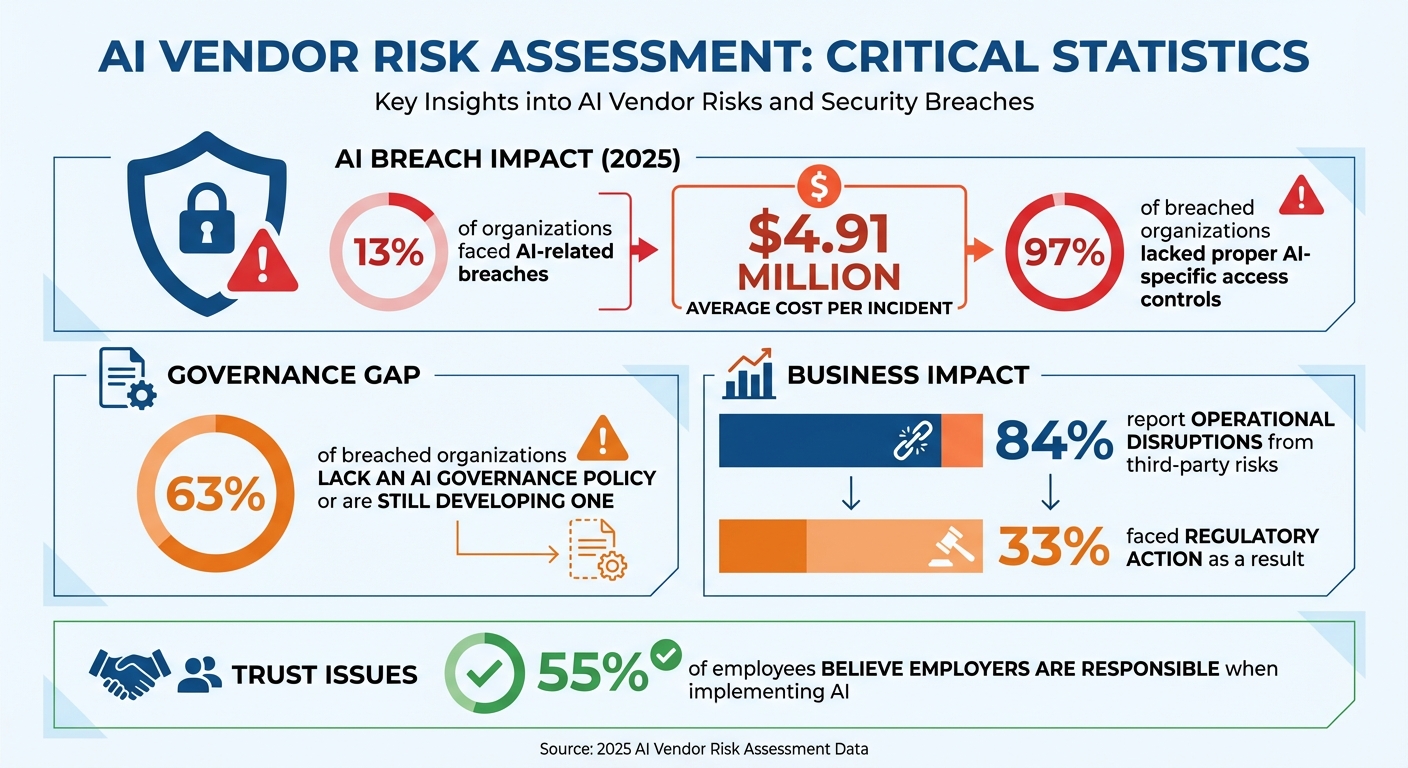
AI Vendor Risk Assessment Statistics and Key Security Metrics 2025
Vendor Background and Credibility
Company Overview
Start by verifying the vendor's legal name, headquarters, and years in operation to establish their credibility baseline. Look into their AI operational maturity by determining whether their systems are customer-facing or internal. Ask for a detailed timeline of key milestones, such as compliance with the EU AI Act, NIST AI RMF, or ISO/IEC 42001 standards. Additionally, assess their extended vendor risk by identifying any reliance on third-party AI vendors or cloud providers like OpenAI or Google. Be sure to review their contingency plans in case these providers discontinue their services.
Reputation and References
Request customer references that provide insights into the vendor's security measures and performance in AI deployment. Also, ask for model or system cards that clearly outline the capabilities, limitations, and intended use cases of their AI systems. Investigate any involvement in public scandals or security breaches over the past three years to gauge their reliability. Avoid accepting vague claims such as "industry-standard security." Instead, demand concrete documentation like SOC 2 reports, ISO 27001 certifications, or redacted incident response reports.
"When your AI vendor gets breached, you inherit that risk." - Nasir R, Atlas Systems
Financial Stability
Examine the vendor’s credit reports and financial records to confirm their ability to operate sustainably in the long term. Request proof of cybersecurity insurance, bonding, and valid business licenses. Verify the presence of documented failover and redundancy measures, historical uptime data, and performance SLAs for their AI services. Additionally, ask for details about their AI development roadmap for the next 12 months to ensure alignment with your needs.
Once the vendor’s credibility, reputation, and financial stability are thoroughly vetted, you can move on to assessing their data governance and security standards to ensure a robust risk management strategy.
sbb-itb-cdb339c
Data Governance and Security
Data Handling and Privacy
When evaluating a vendor, ensure they use AES-256 encryption for protecting data at rest and TLS 1.2 or higher for securing data in transit. It's also critical to confirm that customer data leveraged for AI training is handled with documented consent and kept logically separated to avoid any cross-contamination.
Check that the vendor implements Multi-Factor Authentication (MFA), Single Sign-On (SSO), and Role-Based Access Control (RBAC), adhering to the principle of least privilege. Additionally, request details about their data disposal practices to ensure they comply with NIST SP 800-88 standards, which include methods like overwriting, degaussing, or physical destruction. For environments requiring heightened security, confirm that cryptographic modules meet FIPS 140-2/3 validation standards. Be sure to ask for written policies and recent audit documentation to verify these measures.
Once you're confident in their data handling protocols, shift your attention to their security certifications.
Security Certifications and Audits
Require up-to-date certifications such as SOC 2 Type 2, ISO 27001, and ISO/IEC 42001 (specific to Artificial Intelligence Management Systems). Verify that the vendor performs regular security checks, including monthly internal and external vulnerability scans, as well as annual third-party penetration tests. Ensure critical issues are resolved within 30 to 60 days.
Also, confirm that any subcontractors the vendor uses hold equivalent certifications. Your contract should include audit rights, allowing technical and operational reviews, such as on-site security assessments and vulnerability testing. Consider this: 97% of organizations that experience AI-related breaches lack proper AI access controls, and breaches involving third-party vendors are projected to cost an average of $4.91 million by 2025.
With certifications and audits in place, ensure the vendor's practices align with relevant legal and regulatory standards.
Compliance with Regulations
Clarify the vendor's role - whether they act as a controller, processor, or joint controller - under GDPR. Contracts should outline processing instructions, sub-processor authorizations, and technical safeguards like encryption, pseudonymization, dataset lineage tracking, quality checks, and model explainability.
Request Data Protection Impact Assessments (DPIAs) for the AI system and confirm alignment with frameworks such as the EU AI Act, NIST AI RMF, and ISO/IEC 42001. Ensure the vendor commits to notifying you about data breaches within 24 to 48 hours, as required by regulatory reporting standards. To further validate their privacy measures, ask them to process test documents containing fake personally identifiable information (PII). This step is crucial, especially since 63% of breached organizations either lack an AI governance policy or are still working on one.
"If no decision on the controller and processor relationship has been made, it is likely that all parties will fail to meeting their obligations under the UK GDPR." - Information Commissioner's Office (ICO)
AI Model Development and Transparency
Model Documentation
Transparency in AI model development starts with thorough documentation. Vendors should provide model cards that explain the AI's logic, its training data sources, and performance metrics. These cards should dive into the details - covering datasets, data lineage, data cleaning methods, and proof that the vendor legally owns the rights to use the data for training. Without proper documentation, the risk of intellectual property disputes increases significantly.
Vendors should also offer plain-language explainability reports, even for systems often labeled as "black-box". These reports should include essential metrics like performance benchmarks, bias testing results, drift metrics, and confidence scores. Why does this matter? Because trust in AI is still shaky - only 55% of employees believe their employers are responsible when implementing AI.
"A one-size-fits-all AI solution rarely meets the unique demands of every organization. Customization allows businesses to tailor AI models to their specific workflows, industry challenges and data environments." - Derek Ashmore, Application Transformation Principal, Asperitas
Bias and Accuracy Testing
Bias and accuracy testing are non-negotiable. Vendors should provide detailed documentation about the model's learning methods, potential biases, and metrics like the demographic parity ratio. Testing must happen before deployment, with clear benchmarks such as false positive rates and fairness scores across demographic groups. Avoid settling for vague promises - demand bias audit reports and exact performance metrics.
Accountability doesn’t stop there. Vendors should maintain decision logs for regulatory compliance and be able to produce audit trails when needed. This is especially crucial given the risks: in 2025, 13% of organizations reported breaches involving AI systems, and 63% of those lacked a solid AI governance policy or were still working on one.
Setting clear testing standards lays the groundwork for transparent and responsible AI operations.
Explainability and Accountability
Understanding how an AI model works is essential, especially for high-stakes decisions. Vendors should be able to clearly explain their models' behavior. If they can't, it raises questions about their technical expertise and ability to troubleshoot issues. For critical decisions, vendors must outline the required level of human oversight and provide manual fallback options in case the AI malfunctions or delivers incorrect results.
A trustworthy vendor will also define failure conditions and address risks like model drift, which occurs when data distributions evolve over time. Frameworks such as ISO 42001 or the NIST AI Risk Management Framework can guide these efforts. Beware of vendors who refuse to explain their decision-making processes or hide behind claims of "proprietary algorithms" - this is a major red flag.
"If a vendor cannot explain model behavior, it means they don't understand their own system. This makes debugging impossible and indicates low technical maturity." - Nasir R, Atlas Systems
Contractual Terms and Risk Mitigation
Key Contract Terms
Think of your contract as your safety net - it’s what protects your organization when working with AI vendors. Start by clearly outlining data governance roles. Specify whether the vendor is acting as a data controller or processor, ensuring both parties meet their obligations under data protection laws. It’s also essential to address whether the vendor can train models using your data and to establish clear ownership of both the inputs and outputs.
For AI projects, standard contract terms just won’t cut it. You’ll need to expand definitions to cover AI-specific risks, such as model drift, privacy breaches, and adversarial attacks. Additionally, include accuracy-based Key Performance Indicators (KPIs) or Service Level Agreements (SLAs) that hold vendors accountable for meeting agreed performance standards. For instance, your contract should spell out remedies if a model’s accuracy falls below a specified threshold.
Another critical element is indemnification. Push for uncapped indemnification to cover data incidents, third-party intellectual property violations, and reputational damage caused by AI failures. This is especially important when you consider that 84% of businesses report operational disruptions from third-party risks, and 33% have faced regulatory action as a result. Also, include audit rights so you can periodically review the vendor’s AI outputs and data security measures.
"Even with strong due diligence and monitoring, risk exposure remains if vendor contracts lack enforceable provisions for security, compliance, and business continuity."
- Rod Linsley, Gatekeeper
These contract terms provide a solid foundation to evaluate vendor performance during a trial phase.
Trial or Proof-of-Concept Phase
Before committing to a full rollout, conduct a pilot or proof-of-concept phase with clearly defined success metrics. Be specific about what success looks like - whether it’s achieving a particular accuracy rate, passing bias tests, or demonstrating smooth integration with your existing systems. Set a realistic timeline and establish rollback plans in case the pilot doesn’t meet expectations.
This trial phase is your chance to validate the vendor’s claims and uncover any hidden issues, such as inefficiencies in data handling or unexpected computational costs. Ensure your contract allows you to terminate the agreement if the proof-of-concept fails to meet the agreed benchmarks.
A successful pilot not only builds confidence but also provides clarity on cost structures and exit strategies.
Cost and Exit Strategy
AI pricing models often differ from traditional software pricing, with costs tied to computational usage. This can make it harder to predict the total cost. To avoid surprises, calculate the total cost of ownership, factoring in high usage periods and ongoing support needs. Transparency in payment terms is critical to prevent hidden charges.
Vendor lock-in is another major concern. Your contract should include data portability clauses to ensure you can transition to another provider or internal system without losing access to essential data. Structured transition plans should address data retrieval, secure deletion, and maintaining operational continuity. Additionally, include termination triggers for scenarios like vendor misuse, regulatory scrutiny, or intellectual property disputes.
Considering that third-party vendor compromises can cost businesses an average of $4.91 million, a well-defined exit strategy is not optional - it’s a necessity.
"Include structured exit strategies to prevent disruption in case of termination."
- Rod Linsley, Gatekeeper
VRM 201: Effectively Assessing Vendor AI Risk - Chris Honda
Ongoing Monitoring and Reassessment
Signing a contract is just the starting point for managing vendor relationships - it’s what comes after that really counts. Continuous monitoring is essential to address the risks that can arise as AI systems evolve. Unlike traditional software, AI models change rapidly, and performance can degrade over time due to model drift as data evolves. Without ongoing oversight, a vendor that initially met your standards could become a liability in a matter of months.
Periodic Risk Assessments
Make it a priority to conduct full risk reassessments for all AI vendors at least once a year. For Tier 1 vendors - those managing critical systems or sensitive data - step up the frequency of these reviews. AI models are dynamic and can change unpredictably, so it’s crucial to stay informed. Request updated system or model cards regularly to understand any shifts in capabilities, limitations, or training data. It’s equally important to confirm that vendors aren’t using your proprietary data to train models for other clients without your explicit, ongoing consent.
Don’t overlook the vendor’s AI supply chain. Review their third-party dependencies, such as foundation model providers like OpenAI or Google, as these relationships can introduce additional risks. Beyond uptime metrics, ensure your service-level agreements (SLAs) include measures for accuracy and the quality of outputs.
"A model that's available but producing garbage outputs is worse than no model at all."
- Nasir R, Atlas Systems
These periodic reviews lay the groundwork for effective incident management when problems occur.
Incident Management
Regular risk assessments need to be paired with a robust incident response strategy. Vendors should have a tested incident response plan specifically designed for AI-related issues like data poisoning, prompt injection, or model manipulation. Don’t just take their word for it - ask for evidence that they’ve recently tested their plan under realistic conditions. Audit logs that track inputs, outputs, and anomalies are also critical for accountability.
Clearly define communication protocols in advance. Specify how and when vendors must notify you of security incidents, and include strict reporting timelines in your contract. If an incident occurs, conduct joint root cause analyses to understand what went wrong and how to prevent it in the future.
Continuous Monitoring Tools
Leverage real-time monitoring tools to stay ahead of potential risks. Platforms designed for risk management and threat intelligence can alert you instantly to security incidents, compliance breaches, or operational disruptions. Keep an eye on external signals as well - news reports, vulnerability disclosures, and regulatory updates can all indicate emerging issues with your vendor.
| Monitoring Focus | What to Track | Recommended Frequency |
|---|---|---|
| Performance | Model accuracy, false positives, model drift | Weekly or real-time |
| Security | Prompt injection attempts, access logs | Real-time alerts |
| Compliance | GDPR updates, EU AI Act changes | Monthly reviews |
For critical AI decisions, ensure human oversight is in place. Test manual fallback procedures regularly to guarantee business continuity in case of AI failures.
"Continuous monitoring allows organizations to stay ahead of emerging security threats and swiftly address weaknesses in vendor security practices before they lead to data breaches or operational disruptions."
- Mike Miller, vCISO, Appalachia Technologies
Data Annotation Companies
In AI projects, choosing the right data annotation vendor is crucial. The quality of labeled data directly impacts the accuracy of your AI models, and any security lapses during this process can put sensitive training data at risk.
Data annotation plays a pivotal role in shaping model performance. To start, ensure the vendor can handle multiple data types. Whether your project involves images, videos, audio, text, medical formats like DICOM or NIfTI, or even 3D point cloud data, confirm their capability to support all required formats. Ask for evidence of their experience with large-scale projects, such as managing datasets with over 500,000 images or more than 5 million labels.
Security should be a top priority. Request certifications like SOC 2 reports and confirm the use of advanced encryption methods such as AES-256. Features like Bring Your Own Key (BYOK) can provide additional control over your data. For industries with strict regulations, look for vendors that offer on-premises deployment using tools like Docker, ensuring data stays within your local infrastructure.
Quality assurance is another key factor. Leading vendors implement rigorous QA workflows and human-in-the-loop (HITL) processes to maintain label accuracy. For critical tasks, AI-assisted labeling combined with human review - such as model-assisted labeling (MAL) or tools like the Segment Anything Model (SAM) - can enhance precision. These measures are vital for reducing risks throughout the AI development lifecycle.
For a curated list of reliable providers, visit Data Annotation Companies. This platform highlights vendors with diverse strengths, from enterprise-level platforms with robust compliance standards to specialized services for industries like healthcare, autonomous vehicles, and multilingual NLP applications.
Conclusion
Choosing an AI vendor involves more than the usual software evaluation - it’s about shielding your organization from unique risks. Consider this: 13% of organizations have experienced AI-related breaches, with 97% of them lacking proper access controls. On top of that, third-party compromises have led to average losses of $4.91 million.
These numbers underscore the importance of demanding concrete proof from AI vendors. A strong assessment framework transforms vague assurances into tangible evidence, requiring documentation like SOC 2 reports, penetration testing results, and data isolation protocols. This process helps tackle AI-specific challenges often ignored by traditional vendor risk management, such as training data origins, algorithmic bias, and model drift.
"By adopting the AI Vendor Assessment Framework, organizations are able to bring greater structure, clarity, and consistency to their procurement process." – Megan Areias, Lead Technology and Data Counsel, Kenvue
To streamline evaluations, consider a tiered approach. AI tools handling sensitive information should undergo more rigorous scrutiny, while simpler systems can be evaluated with less intensity. This method saves time without compromising the thoroughness required for critical systems. Annual reassessments are also essential, as AI evolves faster than traditional software, introducing new vulnerabilities over time.
Taking a proactive stance builds trust with stakeholders. With 63% of breached organizations lacking proper AI governance policies, demonstrating a structured risk management strategy sets you apart. Whether you're assessing data annotation services, model development partners, or deployment platforms, this framework ensures you’re asking the right questions before committing to any agreement. By following these steps, you not only protect your investments but also ensure your AI deployments align with modern risk management practices.
FAQs
What are the key risks to watch for when evaluating vendors for AI projects?
When evaluating vendors for AI projects, it’s important to pinpoint potential risks that might affect your outcomes. Here are some key aspects to examine:
- Bias in training data: Make sure the vendor’s data is diverse and well-represented to minimize the risk of unintended biases or discriminatory outcomes.
- Data privacy and security: Confirm that the vendor has strong safeguards in place to protect sensitive information and complies with relevant privacy laws and regulations.
- Model performance and reliability: Assess the accuracy, consistency, and dependability of the AI models they offer to ensure they meet your project’s standards.
- Explainability and human oversight: Look for AI solutions that are easy to interpret and include clear mechanisms for human involvement and monitoring.
- Regulatory compliance: Verify that the vendor adheres to frameworks like the NIST AI Risk Management Framework or legal guidelines such as the EU AI Act.
It’s also a good idea to review the vendor’s policies on data usage and retention to ensure they align with your organization’s values and requirements. By addressing these factors, you can reduce risks and set the foundation for a safer and more effective AI project.
How can I make sure a vendor’s AI models are secure and free from bias?
To ensure an AI vendor's models are both secure and fair, make trustworthiness a priority when evaluating them. Start by requesting detailed documentation about their AI systems. This should cover how they collect and preprocess data, as well as the steps they take to identify and reduce bias. Check for evidence that their models have been tested across diverse populations. Additionally, ask for tools like model cards or feature importance reports to gain insight into how their systems make decisions.
For security, insist on independent evaluations such as penetration tests and adversarial robustness assessments. The vendor should also have a clear incident response plan in place. Verify that they actively monitor for new vulnerabilities and hold certifications like ISO 27001 or SOC 2. If the vendor uses outsourced data annotation, ensure they work with providers that follow strict labeling standards and take measures to minimize bias in training data. These steps help guarantee the reliability and fairness of both the data and the AI models.
What contract terms are essential to reduce risks when working with AI vendors?
When working with an AI vendor, it’s crucial to have a contract that mitigates risks and safeguards your interests. Here are some essential provisions to include:
- Data ownership and intellectual property: Make sure you maintain ownership of all the data you provide and the outputs generated. Additionally, confirm the vendor guarantees that no third-party claims exist on the data they use.
- Performance and accuracy standards: Set clear benchmarks for accuracy, reliability, and explainability. Include remedies, such as service credits or the option to terminate the agreement, if these standards aren’t met.
- Compliance and security: Require the vendor to follow U.S. regulations, like the CCPA, and adhere to recognized frameworks. Also, include audit rights to verify their compliance.
- Indemnification and liability: Ensure the vendor is responsible for issues like data breaches or biased outputs. At the same time, establish fair limits on liability to protect both parties.
- Termination and transition: Define clear exit terms, including the secure return or destruction of your data. Also, require the vendor to assist in transitioning to a new provider if needed.
Including these terms in your agreement helps ensure your AI initiatives remain secure, compliant, and aligned with your broader risk management strategies.