Data Annotation Liability: Who Is Responsible?
· Data Annotation
Clients remain legally responsible for outsourced annotation; reduce GDPR, breach, and bias risks with strict DPAs, vendor vetting, and continuous QA.
Data Annotation Liability: Who Is Responsible?
When outsourcing data annotation, liability issues can arise from mislabeled data, security breaches, or biased outcomes. These problems can lead to financial losses, regulatory penalties, and reputational damage. Here's what you need to know:
- Clients bear primary responsibility for regulatory compliance, even when using third-party vendors.
- Vendors often limit their liability, leaving clients exposed to risks like GDPR fines or lawsuits.
- Annotators' expertise impacts accuracy, and poor-quality annotation can lead to flawed AI performance.
- Legal frameworks like GDPR and CCPA require strict contracts (e.g., Data Processing Agreements) to define roles and obligations.
- Contracts and oversight are critical to managing risks, including clauses for intellectual property, breach notifications, and quality thresholds.
To reduce risks, prioritize vendor vetting, include robust legal protections in contracts, and maintain ongoing quality control. Neglecting these steps can result in costly remediation, regulatory scrutiny, or customer trust issues.
Who Is Responsible in Data Annotation
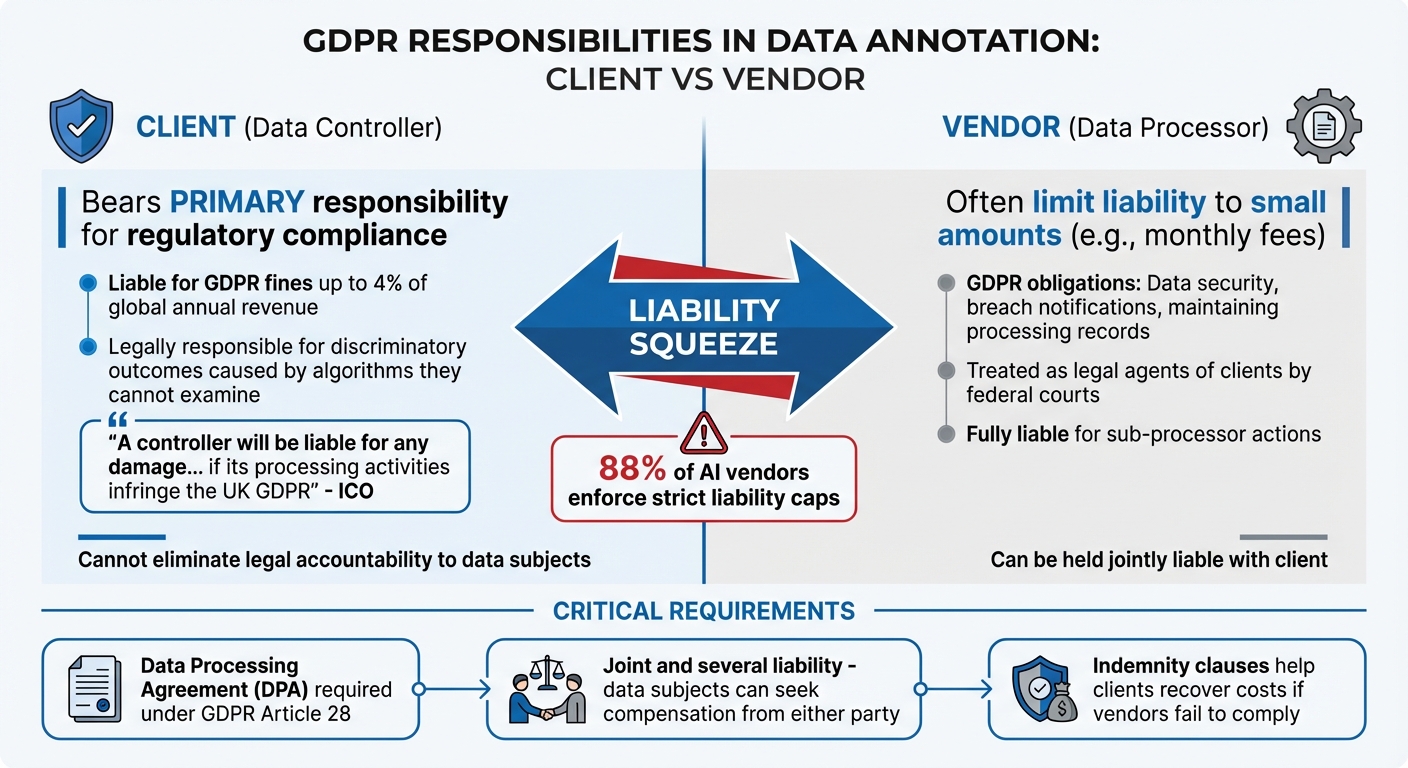
Data Annotation Liability: Client vs Vendor Responsibilities Under GDPR
When it comes to outsourced data annotation, responsibility for errors is shared among clients, vendors, and the annotators themselves. Clearly defining these roles is critical to reducing both legal and operational risks.
Client vs. Vendor: Who Owns the Risk?
Under GDPR, the client acts as the "data controller", while the vendor is the "data processor." This means the client bears the primary responsibility for regulatory compliance. The Information Commissioner's Office (ICO) outlines this dynamic:
"A controller will be liable for any damage... if its processing activities infringe the UK GDPR... [but] may be able to claim back all or part of the amount of compensation from a processor... to the extent that the processor is at fault."
This creates what’s often called a "liability squeeze." Federal courts increasingly treat vendors as legal agents of their clients, but most AI vendors limit their liability to small amounts, like monthly fees, leaving clients exposed. Jason M. Loring, Partner at Jones Walker LLP, captures the challenge:
"The retailer... becomes legally responsible for discriminatory outcomes caused by the algorithms it cannot examine, using the training data it cannot audit, with decision-making logic it cannot fully understand."
While contracts can’t eliminate a client’s legal accountability to data subjects, indemnity clauses in Data Processing Agreements can help recover costs if vendors fail to comply. Vendors also have their own GDPR obligations, such as data security, breach notifications, and maintaining processing records, regardless of what the contract specifies.
However, the risks don’t stop with vendors - annotators themselves introduce additional complexities.
The Role of Annotators in Liability
Annotators can create risks through both data security breaches and errors in their work. Their expertise level plays a significant role in determining the accuracy of the annotated data. For example, generalist crowd workers typically achieve accuracy rates of 65%–75%, while specialized teams, such as those led by attorneys, can exceed 95%. For high-stakes legal AI projects, a Cohen’s Kappa score - used to measure agreement between annotators - should fall between 0.61 and 0.80 at minimum.
One common pitfall is the "A-Team Trap", where vendors use highly skilled annotators during initial pilot phases but later replace them with less experienced staff for production work. This bait-and-switch tactic reduces quality and increases liability for the client. Security risks also loom large: without proper Virtual Desktop Infrastructure (VDI) controls, remote annotators could capture or download sensitive data. A cautionary example is the 2024 Flock Safety case, where a surveillance company employed offshore gig workers via Upwork to annotate sensitive American surveillance data - ranging from children’s audio to faces captured by over 80,000 cameras - without conducting security clearances or background checks.
Vendors typically rely on Quality Assurance (QA) protocols and Inter-Annotator Agreement (IAA) metrics to manage annotator accountability. However, clients must ensure these measures are robust. Courts and regulators consistently emphasize that businesses have a duty of care, no matter where or how the data is processed.
sbb-itb-cdb339c
Legal and Regulatory Frameworks That Impact Liability
Understanding the legal frameworks governing data annotation is essential to managing risks effectively.
Key Regulations: GDPR, CCPA, and Beyond
The General Data Protection Regulation (GDPR) outlines roles and responsibilities between clients and vendors. Article 28 mandates a written Data Processing Agreement (DPA) that specifies obligations and liability limits. Without this agreement, businesses risk fines of up to 4% of their global annual revenue.
In the U.S., regulations like CCPA and CPRA in California impose similar restrictions. Annotation vendors are classified as "Service Providers", and contracts must explicitly prevent them from selling, sharing, or using personal information for anything not outlined in the agreement. California Civil Code § 1798.140(ag) emphasizes that service provider contracts must prohibit "selling or sharing the personal information" and "retaining, using, or disclosing the personal information" for unauthorized purposes.
Other states, including Virginia (VCDPA), Utah (UCPA), and Connecticut (CTDPA), have additional laws that add complexity to compliance efforts. For healthcare-related data, HIPAA requires a Business Associate Agreement (BAA) for vendors managing Protected Health Information (PHI).
Recent enforcement actions underscore the importance of compliance. In May 2023, Ireland's Data Protection Commission imposed a record €1.2 billion fine on Meta, scrutinizing its data flow and contracts with cloud providers. Similarly, France's CNIL fined Google €50 million in 2019 for providing overly vague descriptions of data processing purposes.
How Contracts Reduce Liability
In light of these strict regulations, well-structured contracts are a critical tool for managing liability. While they can't erase your legal responsibility to data subjects, they can define who bears the financial burden when issues arise. Contracts address operational risks by clarifying roles and responsibilities. Under GDPR, both controllers and processors are subject to joint and several liability, allowing a data subject to seek full compensation from either party. If you end up paying the full amount, you can seek reimbursement from your vendor if they're at fault.
Joshua Gray, Associate at Covington & Burling LLP, explains:
"Unless a controller can demonstrate that it is 'not in any way responsible for the event giving rise to the damage,' it will be fully liable for any damage caused by non-compliant processing to ensure a data subject receives effective compensation".
Your DPA should include clear breach notification timelines to meet the GDPR's 72-hour reporting requirement - vague phrases like "undue delay" won't suffice. Key clauses to include are audit rights, sub-processor provisions, and data deletion terms. A study of 200 small businesses found that 73% lacked mandatory DPA clauses in their vendor agreements. If your annotation vendor relies on sub-processors, ensure "back-to-back" contracts are in place, extending data protection obligations throughout the chain. Keep in mind that while the original processor remains fully liable for sub-processor actions, strong contractual terms are necessary to enforce accountability.
How to Manage Liability in Outsourced Annotation
Managing liability in outsourced data annotation requires more than just understanding legal frameworks - it's about building a system of careful vendor selection, airtight contracts, and ongoing oversight. This isn't a one-and-done task; it's an ongoing process that demands attention at every stage.
Vendor Vetting and Selection
Selecting the right vendor is your first step in minimizing liability. Start by asking for full SOC 2 Type II audit reports from the past 12 months - not summaries. For ISO 27001 certification, request the current certificate along with the Statement of Applicability (SoA) to see which controls are in place.
Evaluate their security measures. Do they use Virtual Desktop Infrastructure (VDI) to keep data confined to secure servers? Do they enforce "clean-room" protocols, such as no-phone and no-paper policies, for on-site teams? These practices are critical when handling sensitive data.
Another key metric to request is Cohen’s Kappa scores, which measure inter-annotator agreement. For critical projects, like training legal AI systems, aim for a Kappa score between 0.61 and 0.80. To test vendor reliability, conduct a blind pilot with 2-3 candidates using a dataset that includes 10% ambiguous cases. This will reveal how well they handle uncertainty.
Also, avoid the "A-Team Trap", where vendors assign their best team during the pilot but switch them out later. Insist contractually that at least 70% of the pilot team remains on the project during full production.
| Standard | Evidence to Request | Red Flag |
|---|---|---|
| SOC 2 Type II | Full audit report (past 12 months) | Providing only a SOC 3 summary or expired Type I report |
| ISO 27001 | Current certificate and SoA | Certificate expired over 3 months ago |
| GDPR | Signed DPA and list of sub-processors | Resistance to including "Audit Rights" in the contract |
| Cyber Insurance | Certificate of Insurance (COI) | Coverage limits below acceptable thresholds |
Once a vendor meets these criteria, ensure your contract addresses AI-specific risks in detail.
Contract Clauses You Need
Standard service agreements often fall short when it comes to AI-related risks. To fill the gaps, include an AI Addendum that specifies ownership rights, model training permissions, and liability for outputs.
Ownership of intellectual property should be unambiguous. The contract must state that you retain full ownership of input data, annotated outputs, and any derivative models. Vendors should be prohibited from using your data to train their own models without explicit written consent.
Include indemnification clauses to protect against third-party claims, such as intellectual property infringement or data security breaches. For instance, a healthcare firm in 2026 lost a $3 million annual contract and incurred $380,000 in legal defense costs after an outsourced AI tool violated HIPAA and exhibited bias. Their vendor’s liability was capped at one month's fees, leaving the firm to absorb the losses.
Jana Gouchev, Managing Attorney at Gouchev Law, emphasizes:
"The AI Addendum is where the real protection lives. Your MSA won't cover what matters most".
Define acceptance criteria with measurable quality thresholds, such as 97% accuracy. If deliverables fall short, require the vendor to re-annotate the data at no additional cost. For projects involving sensitive data, include strict breach notification timelines and secure audit rights to verify the vendor’s data handling practices.
Monitoring and Quality Assurance
Even with a solid contract, continuous monitoring is essential. Regularly audit 5-10% of delivered annotations to catch errors early. Use a Golden Set - a meticulously labeled dataset created by your internal team - to benchmark the vendor’s performance and detect quality drift.
For industries like healthcare or legal AI, incorporate Human-in-the-Loop (HITL) review processes to catch issues like hallucinations, bias, or plagiarism that automated systems might miss. Set up clear escalation protocols with response times of 2-4 hours for urgent quality issues to avoid project delays.
Organizations that establish clear quality standards report 40% fewer revision cycles. Addressing data quality problems during production can cost 10x more than fixing them during the annotation phase. Harry Rock, Technical Architect at Vendorfi, sums it up:
"A cheap vendor who causes a GDPR breach or delivers a 70% accuracy rate will ultimately cost 5x more in remediation and model retraining".
If you're unsure where to start, platforms like Data Annotation Companies can help you find vendors with proven compliance and quality assurance records.
Conclusion
Outsourcing data annotation comes with unavoidable legal risks. Courts and regulators increasingly hold clients responsible for AI outcomes, even when third-party vendors handle the annotation process. With AI-related lawsuits nearly doubling since 2022 and a rise in data breaches within AI supply chains, the potential consequences are more serious than ever.
To mitigate these risks, focus on three critical areas: vendor selection, solid contracts, and ongoing quality control. Start by requesting complete SOC 2 Type II audit reports and confirming the vendor’s compliance credentials before signing any agreement. Your contracts should clearly address intellectual property ownership, indemnification clauses, and measurable acceptance criteria. This is especially important given that 88% of AI vendors enforce strict liability caps, which often shift the legal burden back onto you.
It’s also essential to remember that fiduciary and professional responsibilities remain yours, regardless of vendor involvement. For industries like healthcare, legal services, or finance, accountability for the final AI output stays with you, even if the vendor labeled the training data. This makes it crucial to implement human-in-the-loop review systems, maintain detailed audit trails, and benchmark vendor performance against your internal gold-standard datasets.
Proactive management can mean the difference between a successful project and costly legal troubles. Organizations that set clear quality metrics report 40% fewer revision cycles, while poor vendor selection often leads to significantly higher remediation expenses.
If you're looking for vendors with strong compliance and quality assurance practices, platforms like Data Annotation Companies can connect you with partners who understand that deploying AI without proper oversight is a serious risk.
FAQs
If my vendor makes a mistake, am I still legally liable?
Courts are starting to hold end-users responsible for errors tied to AI, even as vendors are being subjected to greater accountability. This means that if your vendor makes a mistake, you could still face legal consequences. To reduce your risk, it's crucial to carefully examine how liability is distributed in your contracts. Understanding these terms can help protect you from potential legal issues.
What contract terms best protect me from annotation breaches or bias?
To protect against breaches or bias in annotation, it's crucial to include specific safeguards in your contracts. These should cover clear liability clauses, strong data security protocols, and comprehensive quality and bias mitigation measures. By outlining these provisions, you create a framework for accountability and reduce the risk of problems arising during the data annotation process.
How can I verify annotation quality and prevent team “bait-and-switch”?
To maintain high annotation standards and prevent issues like team "bait-and-switch", it's crucial to implement clear quality guidelines, perform regular audits, and establish strong Service Level Agreements (SLAs). These SLAs should outline key aspects such as quality metrics, turnaround times, revision policies, and data security requirements.
Additionally, conducting thorough vendor evaluations is essential. Look for compliance certifications like SOC 2, ISO, or GDPR and assess the vendor's operational maturity. When these steps are combined, they create a framework that ensures accountability and delivers consistent results.