Feedback Loops in AI Annotation: Best Practices
· Data Annotation
How human-in-the-loop review, active learning, quality controls and iterative retraining improve annotation accuracy and reduce costly errors.
Feedback Loops in AI Annotation: Best Practices
Feedback loops in AI annotation are all about refining accuracy and reducing errors. Here's how they work: human annotators review AI predictions, correct mistakes, and feed the improved data back into the system. This continuous process enhances AI performance and improves data quality over time.
Key takeaways:
- Poor data quality costs businesses $12.9M annually. Feedback loops mitigate this by catching errors early.
- Focus human effort on edge cases (e.g., sarcasm, negation) and low-confidence predictions.
- Use clear guidelines, active learning, and iterative model retraining for better outcomes.
- Quality control measures like inter-annotator agreement and expert reviews ensure consistency.
- Automation (e.g., QA bots, active learning) saves time and prioritizes critical tasks.
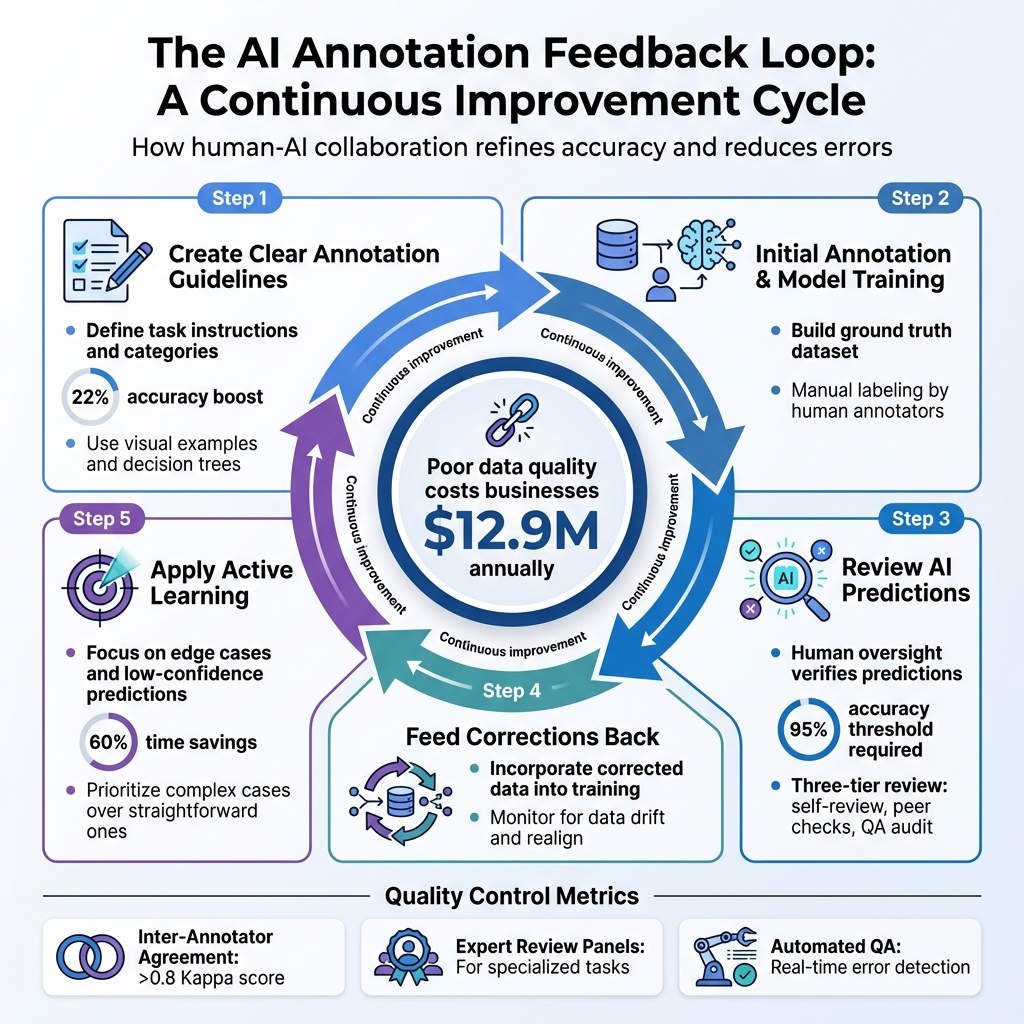
AI Annotation Feedback Loop: 5-Step Process for Improving Model Accuracy
Checklist: Core Components of Feedback Loops
Create Clear Annotation Guidelines
Annotation guidelines should evolve as new edge cases emerge. Start with well-defined task instructions and clear categories. For example, decide upfront if "smart fridges" fall under electronics or appliances. A global e-commerce company boosted annotation accuracy by 22% in just one quarter by clarifying these category rules.
Visual examples can be a game-changer. Show annotators what correct and incorrect annotations look like side-by-side. Take the case of an autonomous vehicle startup in 2025: they required annotators to reach 95% accuracy on a "Gold Standard" pedestrian dataset before moving to production images. This approach halved their error rates. Decision trees can also help annotators handle tricky scenarios consistently. And don’t forget to create a feedback channel where annotators can flag unclear instructions in real time.
Before scaling up, run a pilot. Have multiple annotators label the same data independently. A language processing firm did this for sarcasm detection and discovered their inter-annotator agreement was below 0.6. By revising their guidelines with specific cultural examples, they raised consistency to 0.82, directly improving their model's performance.
Start with Initial Annotation and Model Training
Once your guidelines are in place, kick off the training phase. Begin with a high-quality dataset that's manually labeled by human annotators. This "ground truth" dataset sets a baseline for accuracy and provides the patterns your AI will learn from. Focus on creating a dataset that’s both diverse and accurate, representing the full range of scenarios your model might encounter. A solid foundation like this is key to building an effective feedback loop.
Review AI Predictions with Human Annotators
After initial training, bring in human oversight. Use a cyclical workflow where the model makes predictions on new data, and human reviewers verify these predictions. This model-in-the-loop approach is far more efficient than labeling everything manually from scratch. Set confidence thresholds so that predictions with low certainty trigger automatic alerts for human review.
For thorough quality control, establish a three-tier review process: self-review by the annotator, peer cross-checks, and a final QA audit. This layered review structure helps catch mistakes at multiple points and ensures consistent interpretation of the guidelines across your team.
Use Feedback for Model Retraining
Once human reviewers have verified and corrected predictions, feed those corrections back into the training process. This keeps the feedback loop active. Each retraining cycle should incorporate both the corrected data and any updates to the guidelines that arise from handling edge cases. This process keeps annotators engaged, as they can see how their input directly impacts the model’s performance.
Be on the lookout for data drift - when real-world data starts to differ from your training set. If this happens, launch another annotation round to realign the model. Regular calibration sessions can also help, allowing annotators to discuss challenging cases and maintain a shared understanding of the guidelines.
Apply Active Learning Methods
Active learning can help you focus human effort where it matters most: on low-confidence predictions and complex cases. For example, in satellite imaging tasks, active learning has been shown to save up to 60% of annotation time.
This approach ensures that human reviewers spend their time on edge cases that will have the biggest impact on improving model performance, instead of reviewing thousands of straightforward predictions. It’s a smart way to make the most of your team’s efforts while refining your AI system.
Checklist: Quality Control Measures
Measure Inter-Annotator Agreement
Keeping annotators on the same page is crucial for ensuring consistent labeling. One way to do this is by measuring Inter-Annotator Agreement (IAA), which uses statistical tools to highlight areas where your guidelines might need tweaking. For instance, Cohen's Kappa works well when two annotators are involved, while Fleiss' Kappa is better suited for tasks with multiple annotators. For computer vision projects, Intersection over Union (IoU) is often the go-to metric, and Krippendorff's Alpha is a flexible choice that accommodates various data types and annotator setups.
Set clear benchmarks for these metrics: aim for a Kappa score above 0.8 to signal strong agreement, scores between 0.6 and 0.8 for moderate consistency, and anything below 0.6 as a red flag for potential issues. For IoU in computer vision, a score above 0.7 is generally a good target.
"Maintaining IAA above 0.8 is essential for training reliable AI systems. Lower agreement introduces label noise that degrades model performance".
To calculate IAA effectively, allocate 5–10% of your dataset for redundant annotations. Rotate which items receive multiple reviews to ensure the sample represents the entire dataset. Weekly calculations of agreement metrics can catch potential problems early, preventing them from snowballing. This approach can help teams identify quality issues up to three times faster than relying on sporadic reviews. Adding "honeypots" - expert-labeled tasks - into the workflow is another way to measure individual annotator accuracy against a known standard.
Once these benchmarks are in place, the next step is expert validation.
Set Up Expert Review Panels
For tasks that require specialized knowledge - like medical imaging or legal document reviews - it's best to involve senior annotators or domain experts. Choose reviewers who consistently deliver high-quality work. These experts should focus on areas prone to errors, such as edge cases, complex categories, or labels created by newer team members.
Start by manually reviewing 100% of small batches to establish a quality baseline. Once standards are clear, transition to percentage-based audits. Implement a regular review schedule: daily checks for new labels and weekly sessions to tackle high-disagreement cases. Use platform filters to direct experts to specific problem areas, such as classes with frequent errors or low-performing annotators. Instead of simply approving or rejecting labels, reviewers should provide detailed, written feedback to help annotators improve.
These expert panels play a vital role in addressing nuanced cases that automated systems might overlook.
Use Automated Quality Checks
To complement human oversight, leverage automated tools that can catch errors in real time. These tools reduce the workload on manual reviewers by flagging issues as they happen. For example, QA bots can instantly detect syntax errors or logical inconsistencies, giving immediate feedback to annotators and preventing low-quality submissions from slipping through.
Automated systems can also prioritize human review for annotations with low agreement or uncertainty. Features like consensus algorithms and active learning methods help focus attention where it’s needed most. Randomized or targeted automated review queues further minimize human bias during audits.
Here’s a quick look at how different automated checks can be applied:
| Automated Check Type | Primary Function | Best Use Case |
|---|---|---|
| Honeypot | Assess individual accuracy | Validating new teams or standards |
| Consensus | Measure team consistency | Subjective tasks (e.g., sentiment analysis) |
| QA Bot | Real-time error detection | Catching syntax or basic logical errors |
| Active Learning | Prioritize uncertain data | Large datasets with limited review capacity |
| Benchmark | Compare to "Gold Standard" | Objective tasks with one correct answer |
Checklist: Scaling and Collaboration Methods
Use Collaboration Tools
As your annotation team grows, keeping everyone on the same page becomes increasingly challenging. To address this, popular collaboration platforms come equipped with features like role-based access, issue tracking, and audit logs to streamline workflows effectively.
One standout feature is the issues and questions panel, where labelers can raise questions directly on specific assets. Reviewers or managers can then respond in the same space, ensuring clarity and quick resolution. Additionally, audit logs provide a detailed record of every data row's progress - from "To Label" to "Done" - to ensure no steps are missed during scaling. For more complex projects, some platforms can handle up to 10 distinct review tasks within a single automated workflow.
To complement these tools, integrate external communication platforms like Slack, Microsoft Teams, or Zoom for regular syncs and discussions about nuanced feedback. These tools help maintain a consistent feedback loop, which is critical for refining annotations. Once your team is aligned through collaboration tools, automating repetitive tasks can further enhance efficiency.
Automate Repetitive Tasks
Automation plays a key role in scaling while maintaining quality. One approach, model-assisted labeling, leverages AI to create initial annotations that humans later refine. This method not only improves accuracy by 12% but also saves 60% of the time, allowing human annotators to focus on more complex edge cases.
Other automation techniques, like programmatic QA and automated workflow routing, help reduce manual effort. For example, QA bots can catch basic errors before human reviewers step in. Additionally, platforms with webhooks and APIs enable custom automations - whether through no-code tools like Zapier or Lambda functions - to automatically move data between workflow stages. Automation ensures tasks are routed appropriately based on quality status, streamlining the review process.
Begin with a calibration phase using a small data subset to train your team and identify edge cases before scaling up. Once quality stabilizes, transition into a production phase, where automation handles routine tasks while humans focus on more challenging decisions. This feedback loop also supports continuous model retraining, further improving quality over time.
Define Clear Metrics and Timelines
Scaling effectively requires well-defined metrics and timelines. Start by setting minimum quality thresholds before entering production - such as requiring annotators to achieve at least 95% accuracy on benchmark datasets. These benchmarks ensure quality remains consistent as your team expands.
Break projects into milestones to test the model earlier and refine guidelines between batches. Track key performance indicators like SLAs, throughput, open issue counts, and review scores to monitor progress and maintain high standards.
Regular review cycles are also essential. For example, conduct daily reviews for new labels or weekly reviews for cases with high disagreement to catch potential issues early. Selecting the right tools and metrics from the outset can lead to an average 12% boost in model performance, making these initial decisions critical.
sbb-itb-cdb339c
Checklist: Common Mistakes to Avoid
Avoid Overly Strict Guidelines
While quality control is essential, overly rigid guidelines can backfire by limiting annotators' ability to handle nuanced cases like ambiguous sentiment, sarcasm, or subtle cultural differences. This lack of flexibility can result in models that struggle in practical applications.
Think of guidelines as living documents. For example, a global e-commerce platform saw a 22% boost in annotation accuracy within a single quarter by allowing more flexibility for ambiguous items. The key is to strike a balance: offer clear rules for common situations but give annotators the freedom to use their expertise when encountering unique or unexpected cases.
Encourage annotators to flag unclear instructions and hold regular calibration sessions to ensure everyone interprets the guidelines consistently. As Cassie Kozyrkov, Chief Decision Scientist at Google, aptly reminds us:
"Newsflash: Ground truth isn't true. It's an ideal expected result according to the people in charge".
Address Edge Cases
AI models often stumble when dealing with rare or complex scenarios like regional slang, sarcasm, negation, or missing conditions in medical diagnostics. Focusing only on positive examples while neglecting negative ones can lead to "hallucinations", where the AI detects patterns that don't actually exist.
One way to tackle this is by using active learning to prioritize uncertain or low-confidence predictions for human review. For highly subjective cases - like distinguishing sarcasm from humor - having 3–5 annotators reach a consensus can minimize individual biases. Starting with a pilot phase where multiple annotators independently label the same dataset can also help identify gaps in your guidelines before scaling up the project.
Run Sufficient Iteration Cycles
A single pass at labeling and training is rarely enough. Even Google's Gemini 2.5 Pro failed 70% of real-world office tasks, underscoring the importance of ongoing refinement.
A complete iteration cycle involves revisiting corrected labels, retraining the model, and testing its performance on fresh data to ensure it has improved. Breaking the project into smaller milestones allows for earlier testing and guideline adjustments between batches, which helps catch issues before they snowball. On the other hand, a "waterfall" approach - labeling all data at once - can lead to costly rework later.
To manage costs during iterations, consider evaluating 1–5% of random production outputs as a baseline and supplement this with user feedback to identify errors and low-confidence predictions. As Vahan Petrosyan, Co-founder & CEO of SuperAnnotate, puts it:
"Creating high-quality AI data is extremely complex and time-consuming, but essential for training, improving and evaluating Agents, models and really any enterprise AI system".
These iterative cycles create a dynamic feedback loop that drives continuous improvement.
Adversarial Drifts, Model Monitoring, and Feedback Loops: Building Human-in-the-Loop Machine Learnin
Conclusion and Key Takeaways
Feedback loops play a crucial role in fine-tuning AI annotation processes, ensuring models stay accurate and relevant over time. Without these loops, even the most advanced models risk losing their edge when faced with new data patterns.
The checklist pulls together a range of strategies into a unified system. It emphasizes clear guidelines to set expectations, active learning to focus on critical examples, quality control to catch errors early, and iterative cycles to adapt as data evolves. As Alice Desthuilliers, Principal Product Manager at Appen, puts it:
"Feedback, whether automated or human, is the key ingredient for improving quality. It trains contributors, reinforces good behavior, and uses incorrect responses to identify areas for improvement".
The impact of these practices is undeniable. Organizations that adopt them have reported noticeable gains in accuracy, efficiency, and turnaround times. Beyond numbers, feedback loops empower annotation teams to take on a more strategic role, refining both the guidelines and the model's performance over time.
To transform your annotation process, start by focusing on the essentials: establish clear guidelines, leverage active learning, enforce quality control, and retrain iteratively. Treat your annotation guidelines as evolving resources, maintain open communication with your annotators, and prioritize impactful corrections to maximize accuracy. By building strong feedback loops now, you can sidestep expensive retraining and performance challenges down the road.
FAQs
How do feedback loops enhance the accuracy of AI data annotation?
Feedback loops play a key role in boosting annotation accuracy by establishing a continuous, self-improving process. Here’s how it works: annotators label the data, the model is retrained using those labels, and then its predictions for the next batch are reviewed by the annotators. This back-and-forth process allows errors - like ambiguous or incorrect tags - to be spotted and fixed quickly, resulting in cleaner data and minimizing the chances of systematic biases creeping in.
Refining the annotation process early through feedback loops also helps annotators handle tricky edge cases more consistently, improving the overall quality of training data. The payoff? Faster model learning, fewer rounds of re-labeling, and more dependable performance when the model is used in practical, real-world scenarios. For organizations, adopting these workflows can be a game-changer, ensuring their AI systems remain accurate and reliable over time.
How does active learning enhance feedback loops in AI annotation?
Active learning plays a crucial role in creating effective feedback loops for AI annotation projects. By identifying the data points that are most uncertain or hold the most value, it directs human reviewers to focus on examples that can make the biggest difference in improving the model. This targeted method not only sharpens the model's accuracy but also cuts down on the time and effort needed for labeling.
Once the annotations are validated, they are fed back into the training process. This allows the model to learn from corrections and fine-tune its predictions. The result is a continuous improvement cycle where each iteration enhances the model's performance, reduces inefficiencies in labeling, and boosts overall data quality. By blending human expertise with machine learning, active learning creates feedback loops that are quicker, smarter, and more efficient.
Why is inter-annotator agreement important for ensuring data quality?
Inter-annotator agreement (IAA) plays a key role in ensuring high-quality data for AI annotation projects. It evaluates how consistently multiple annotators label the same set of data, which helps confirm that the labeling guidelines are clear and easy to follow. When IAA is high, it signals that the annotations are reliable and consistent - an essential foundation for training accurate AI models.
On the flip side, low IAA often points to issues like unclear guidelines or tricky edge cases that need attention. Catching these problems early through feedback loops allows teams to fine-tune instructions, fix problematic annotations, and boost the overall quality of the dataset. This proactive approach minimizes errors and biases in the training data, leading to better-performing models and fewer costly mistakes later on.
For organizations that outsource annotation work, partnering with experienced providers who prioritize robust IAA checks can make this process smoother and ensure top-notch data quality right from the beginning.