How to Choose a Domain-Specific Labeling Provider
· Data Annotation
Evaluate labeling vendors by checking domain expertise, quality controls, security, scalability, and integration, then validate with a pilot test.
How to Choose a Domain-Specific Labeling Provider
Choosing the right domain-specific labeling provider is critical for building accurate and reliable AI systems in specialized fields like healthcare, finance, and manufacturing. Here’s what you need to know upfront:
- Domain Expertise Matters: Look for providers with professionals skilled in your industry (e.g., radiologists for medical data or financial analysts for fraud detection).
- Quality Control is Key: Ensure they use methods like multi-level validation, gold standard testing, and consensus reviews to minimize errors.
- Scalability and Security: The provider should handle large-scale projects efficiently while meeting standards like GDPR, HIPAA, or SOC 2.
- Technology Compatibility: Their platform should integrate smoothly with your AI systems, support industry-specific formats, and offer automation tools for efficiency.
Why It’s Important: Poor labeling can reduce AI performance, cost businesses up to 15% of revenue, and lead to serious risks in high-stakes industries. A thorough evaluation process - including pilot tests and reference checks - can help you make the right choice.
For a successful partnership, prioritize expertise, quality assurance, and seamless integration over price alone.
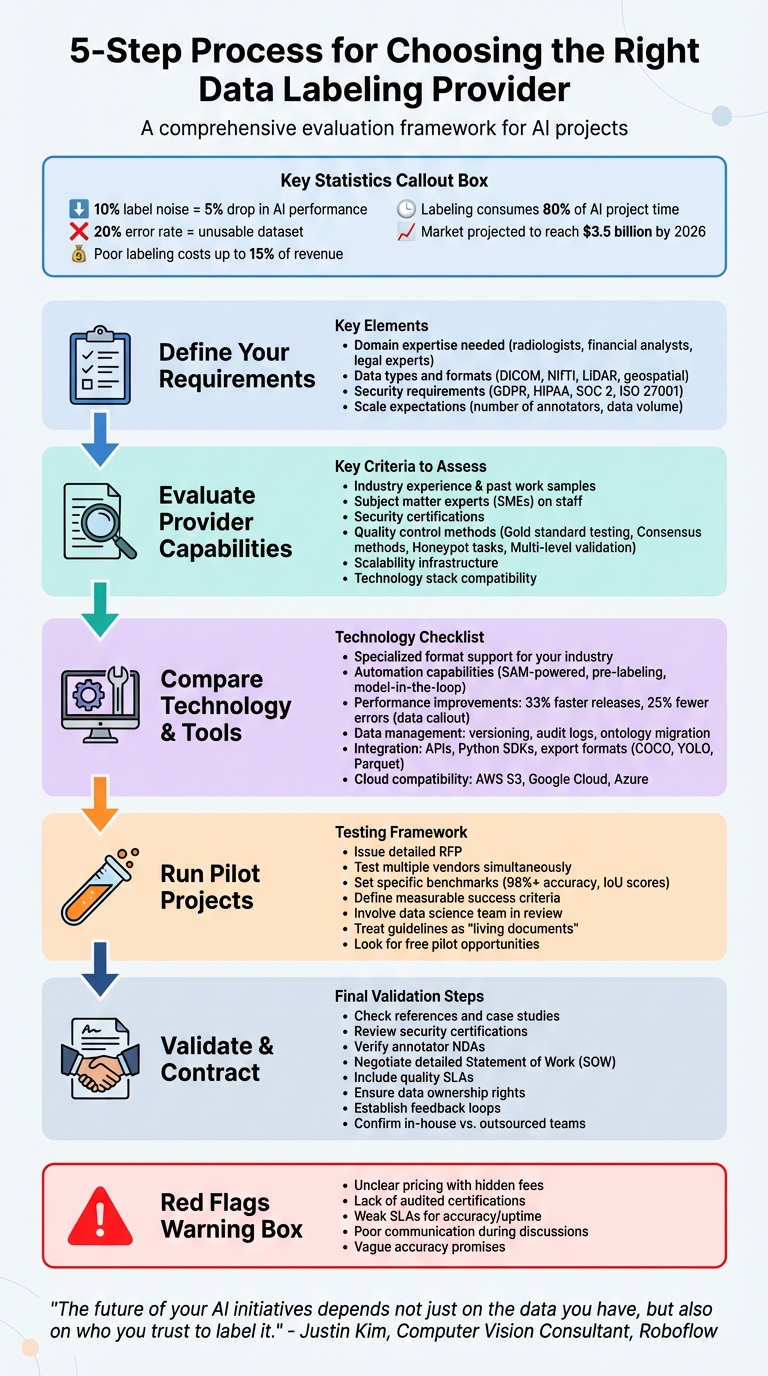
5-Step Process for Choosing a Domain-Specific Data Labeling Provider
What to Look for in a Provider
Industry Experience and Past Work
When choosing a provider, ensure they have subject matter experts (SMEs) with specialized knowledge relevant to your field. For example, in medical imaging, this might mean employing radiologists, while in legal document analysis, it could involve legal experts. These professionals can identify edge cases and apply nuanced judgment that general annotators might overlook.
Ask to see samples of their previous work, along with details about the scale and complexity of those projects. Providers with a strong history in areas like medical imaging or legal analysis are better positioned to tackle the unique challenges of your industry. Additionally, confirm their security certifications - such as ISO 27001, SOC 2, HIPAA for healthcare data, or GDPR compliance for privacy protection. These certifications highlight their ability to handle sensitive data securely and accurately, which is critical for high-stakes AI applications.
Quality Control Methods
Expertise alone isn’t enough - strong quality control measures are just as important. Look for providers that use multi-level validation techniques, including:
- Gold Standard testing: Comparing annotations to pre-verified answers.
- Consensus methods: Having multiple annotators review the same data.
- Honeypots: Embedding tasks with known answers to assess annotator performance.
Even small errors can have significant consequences. Studies show that a 20% error rate can make a dataset unusable, while just 10% label noise can reduce AI model performance by up to 5%.
"Make sure your vendor can clearly explain how they run their process and back up any promises they made." - Andrey Chernov, Head of Labeling, CVAT
Request quality assurance (QA) reports that track errors and confirm whether the provider uses in-house teams for tighter control. The best providers maintain a closed feedback loop, allowing annotators to receive ongoing feedback while sharing insights on edge cases. Before committing, ask for a proof of concept to evaluate their ability to meet your quality expectations.
Ability to Scale and Adapt
Scalability and adaptability are vital for long-term project success. A reliable provider should handle increased workloads without compromising quality. Ask about their workforce management: Can they quickly onboard additional annotators - say, 50 or more - to meet growing demands?
Assess their operational infrastructure as well. Scalable providers often use task templates, role-based workflows, and modular task designs to streamline processes across projects. They should offer API access for smooth data integration and support real-time updates to instructions without disrupting ongoing work. To test their adaptability, consider running a stress-test pilot that includes edge cases and intentionally change guidelines mid-project. This will reveal how effectively they manage the "label-test-adjust-relabel" cycle. A provider capable of scaling efficiently will help your project evolve seamlessly, even in complex, high-stakes environments.
Reviewing Technology and Tools
Annotation Software and Automation
The software your data labeling provider uses plays a critical role in determining both speed and accuracy. It's essential to choose platforms that support specialized formats tailored to your industry. For example, medical imaging often requires DICOM or NIfTI, autonomous vehicles benefit from LiDAR and 3D point cloud support, and agriculture relies on geospatial imagery formats. If the platform doesn’t natively support these formats, you risk wasting time and potentially losing metadata during conversions.
Automation is another game-changer. Tools equipped with SAM-powered (Segment Anything Model) auto-annotation, pre-labeling, and model-in-the-loop workflows can handle repetitive tasks, freeing up human annotators to focus on edge cases and quality assurance. Platforms like V7, for instance, have been shown to speed up model releases by 33% while cutting errors by 25% within just six months. However, automation is only as effective as the quality standards backing it, so ensure the platform enforces rigorous QA processes.
"Firms achieve the most significant performance improvements when humans and machines work together." - Paul Daugherty and Jim Wilson, Accenture
Additionally, robust data management features are a must. Look for tools offering dataset versioning, ontology migration, and immutable audit logs. These capabilities are especially vital in regulated industries, where tracking every change from raw data to the final labeled version is non-negotiable. Ergonomic features for annotators - such as hotkeys, snap-to-edge tools, and low click-depth for repetitive actions - also matter. A user-friendly interface reduces errors and speeds up workflows. Finally, ensure the platform integrates seamlessly with your existing AI systems, so there are no bottlenecks in transitioning from labeled data to model training.
Compatibility with Your AI Systems
Even the most advanced labeling tools can fall short if they don’t integrate smoothly with your AI infrastructure. Before making a commitment, confirm that the provider offers robust APIs and Python SDKs to connect their platform directly to your MLOps pipeline. As Marta Szyndlar from V7 Labs explains, "A data labeling tool is just one component of your MLOps pipeline, meaning seamless integration with the rest of your tech stack is non-negotiable".
The platform should support export formats like COCO, YOLO, and Parquet without requiring additional conversion steps. This ensures your labeled data flows directly into training models, saving time and effort. Check for compatibility with cloud storage solutions like AWS S3, Google Cloud Storage, and Azure, as well as options for on-premise or encrypted data storage, depending on your security needs.
It’s wise to conduct a proof-of-concept using real production data to validate integration. For instance, in 2025, the Swiss Data Science Center processed 2.3 million surgical video frames in just one month by integrating Lightly AI's selection strategies into their existing pipeline. This allowed them to achieve a 10x faster annotation workflow for YOLOv8 instrument detection. Similarly, agricultural robotics company Aigen used automated edge-case identification to reduce their dataset size by 80–90% while doubling deployment efficiency across various lighting conditions. These examples highlight how proper integration can dramatically improve project timelines and outcomes - but only if compatibility is thoroughly tested upfront.
sbb-itb-cdb339c
How to Select the Right Provider
Compare Providers Side by Side
Creating a solid comparison framework is essential for objectively evaluating vendors, rather than relying solely on their marketing claims. Start by issuing a detailed RFP that clearly outlines your project goals, data types, quality expectations, and the level of domain expertise required.
When comparing providers, focus on the factors that will directly influence your project's success. Key areas to assess include: quality assurance processes, domain expertise in your industry, scalability to manage your data needs, technology stack (such as AI tools and API integrations), and security certifications like GDPR, HIPAA, or SOC 2. Additionally, consider their workforce model - managed teams often deliver higher accuracy but come at a higher cost.
"Choosing a data labeling tool isn't just about selecting required features... but also identifying and avoiding situations of inflated cost, data security, and output data quality." - Vikram Kedlaya, Author, Taskmonk
Be cautious of red flags during your evaluation process. These could include unclear pricing with hidden fees, lack of audited security certifications, weak Service Level Agreements (SLAs) for accuracy or uptime, and poor communication during initial discussions. Keep in mind that low-quality data labeling can lead to poorly trained models, which may cost companies as much as 15% of their total revenue.
Once you've compared providers' capabilities, validate their claims by running a pilot project.
Run a Test Project First
Before committing to a provider, conduct a time-limited pilot project to evaluate their performance. This step allows you to test their real-world capabilities against your comparison framework. Clearly define deadlines and measurable success criteria, such as speed, communication, and accuracy.
The best way to assess providers is to test multiple vendors simultaneously. This side-by-side approach makes it easier to compare their efficiency and the quality of their outputs. Set specific benchmarks upfront - for example, requiring 98%+ accuracy or achieving certain computer vision metrics like Intersection over Union (IoU) scores. Involve your data science team in reviewing the pilot results; they'll be better equipped to catch subtle errors that might go unnoticed by project managers.
Use the pilot phase to refine your annotation guidelines, treating them as a "living document". Analyze the results to identify areas for improvement and address any errors before scaling up. Some providers even offer free pilot projects with no commitment, giving you a risk-free opportunity to evaluate their capabilities. If a vendor struggles to deliver quality on a small sample, they’re unlikely to perform better at scale.
Check References and Negotiate Contracts
To ensure the provider has a reliable track record, review their case studies, testimonials, and references. Confirm that they hold relevant security certifications and that individual annotators have signed confidentiality agreements, not just the company itself.
Your contract should include a detailed Statement of Work (SOW) that outlines project goals, deliverables, workflows, scalability requirements, and delivery timelines. Incorporate specific SLAs for quality and formalized pricing models. Make sure the contract explicitly states that you retain full ownership of all labels, prompts, and instructions generated during the project.
Before sharing any data, even for a pilot project, require the provider to sign a Non-Disclosure Agreement (NDA). Determine whether their annotators are in-house or outsourced, as in-house teams often provide better training and tighter data security. Lastly, ensure the contract includes a feedback loop, enabling your team to communicate directly with annotators for continuous quality improvements.
Conclusion: Finding the Right Provider
Choosing the right labeling provider is a key decision that can significantly impact the success of your AI project. High-quality training data is non-negotiable - just a 10% label noise can lower accuracy by up to 5%, while a 20% error rate can make a dataset practically unusable.
When evaluating providers, focus on three essential factors: domain expertise, quality control, and scalability. Specialized fields like medical imaging or legal terminology demand more than generic teams can offer, and providers without strong validation processes can lead to expensive mistakes. In fact, poorly labeled data can cost companies as much as 15% of their revenue, making it vital to thoroughly assess potential partners. These steps form the groundwork for the strategies outlined in the next sections.
As industry expert Justin Kim, Computer Vision Consultant at Roboflow, puts it:
"The future of your AI initiatives depends not just on the data you have, but also on who you trust to label it."
To avoid hidden costs and subpar quality, adopt a thorough evaluation process. This includes issuing detailed RFPs, running pilot projects, and checking references. With the market for data labeling projected to reach $3.5 billion by 2026, and labeling consuming 80% of the time spent on AI projects, partnering with a provider who can scale effectively while maintaining accuracy is a clear competitive edge.
Finally, prioritize transparency over price. Providers offering vague pricing or unrealistic accuracy promises may end up costing more in the long run due to hidden fees or quality issues. Instead, seek partners who offer clear communication, possess recognized security certifications, and are open to demonstrating their capabilities through small-scale tests before you make a commitment.
FAQs
What quality control methods should you look for in a domain-specific data labeling provider?
When choosing a data labeling provider, it's essential to focus on their quality control measures to guarantee accurate and dependable results. Opt for providers that have multi-level review systems in place. This means annotations are reviewed by multiple experts or senior reviewers, and any inconsistencies are resolved through a structured reconciliation process. Providers that incorporate client feedback loops - allowing you to highlight issues and request timely re-reviews - show they are dedicated to maintaining high standards.
It's also important to check if the provider employs automated validation checks, such as format verification or out-of-range detection, alongside statistical sampling or spot-checking to track accuracy and consistency. Transparent audit trails, which record who annotated the data and when, add another layer of accountability. By selecting a provider with these comprehensive quality control practices, you can minimize errors and enhance the effectiveness of your AI model.
How can I make sure a data labeling provider works well with my current AI systems?
To make sure a data labeling provider works well with your AI systems, start by confirming their tools align with your existing tech stack. Check if they support your data formats, like JSONL or COCO, and ensure they integrate easily into your workflows, such as model training pipelines or version control systems. Request thorough documentation for their APIs or SDKs to verify compatibility with your security protocols, such as OAuth 2.0 or API key authentication.
Next, consider running a pilot project to evaluate their performance in a practical setting. Pay close attention to metrics like latency, error rates, and scalability to confirm they can meet your production demands. Additionally, ensure the provider offers continuous support, flexible options for updating labels, and compliance with important regulations like HIPAA or GDPR. Taking these steps will help you integrate the provider seamlessly without causing disruptions to your AI operations.
What should I look for to ensure a labeling provider can scale and adapt to my project needs?
When assessing a provider's ability to grow with your needs, pay attention to how well they manage increasing workloads, adapt to changing requirements, and integrate with your existing systems. They should be capable of handling your current data volume while scaling up during busy periods without sacrificing quality or missing deadlines. Look for consistent turnaround times and measurable capacity benchmarks to gauge their reliability.
Also, find out if they use a combination of skilled annotators and automation tools, like pre-labeling models or API-driven workflows, to meet shifting project demands efficiently. It's equally important that their platform works seamlessly with your tools and allows for simple updates to labeling guidelines or taxonomies. This flexibility can help minimize disruptions as your needs evolve.