How Real-Time Annotation Improves AI Models
· Data Annotation
Streaming labels let AI learn and adapt instantly—cutting latency to milliseconds, reducing bias, and enabling continuous retraining with human-AI workflows.
How Real-Time Annotation Improves AI Models
Real-time annotation labels data as it streams, enabling AI systems to learn and update without delays. Unlike batch methods, which process data in bulk after collection, real-time annotation ensures that AI models work with the most current information. This approach is especially useful in applications like fraud detection and autonomous vehicles, where decisions need to be made quickly.
Key Takeaways:
- Speed: Processes data in milliseconds versus hours or days in batch methods.
- Accuracy: Combines AI pre-labeling with human validation, achieving 95–98% accuracy.
- Continuous Updates: Prevents "data drift" by feeding fresh data directly into training pipelines.
- Cost Efficiency: Reduces manual work by focusing human review on complex cases.
- Applications: Useful in fields requiring fast responses, like healthcare, finance, and real-time monitoring.
Real-time annotation uses tools like Apache Kafka and AWS Kinesis to handle large data streams, paired with human-AI workflows for quality assurance. Outsourcing to expert providers can simplify implementation and reduce setup time. This method is critical for maintaining effective AI systems in dynamic environments.
Features | Real-time Annotation Quality Check with Customized Rules
sbb-itb-cdb339c
Real-Time Annotation vs. Traditional Methods
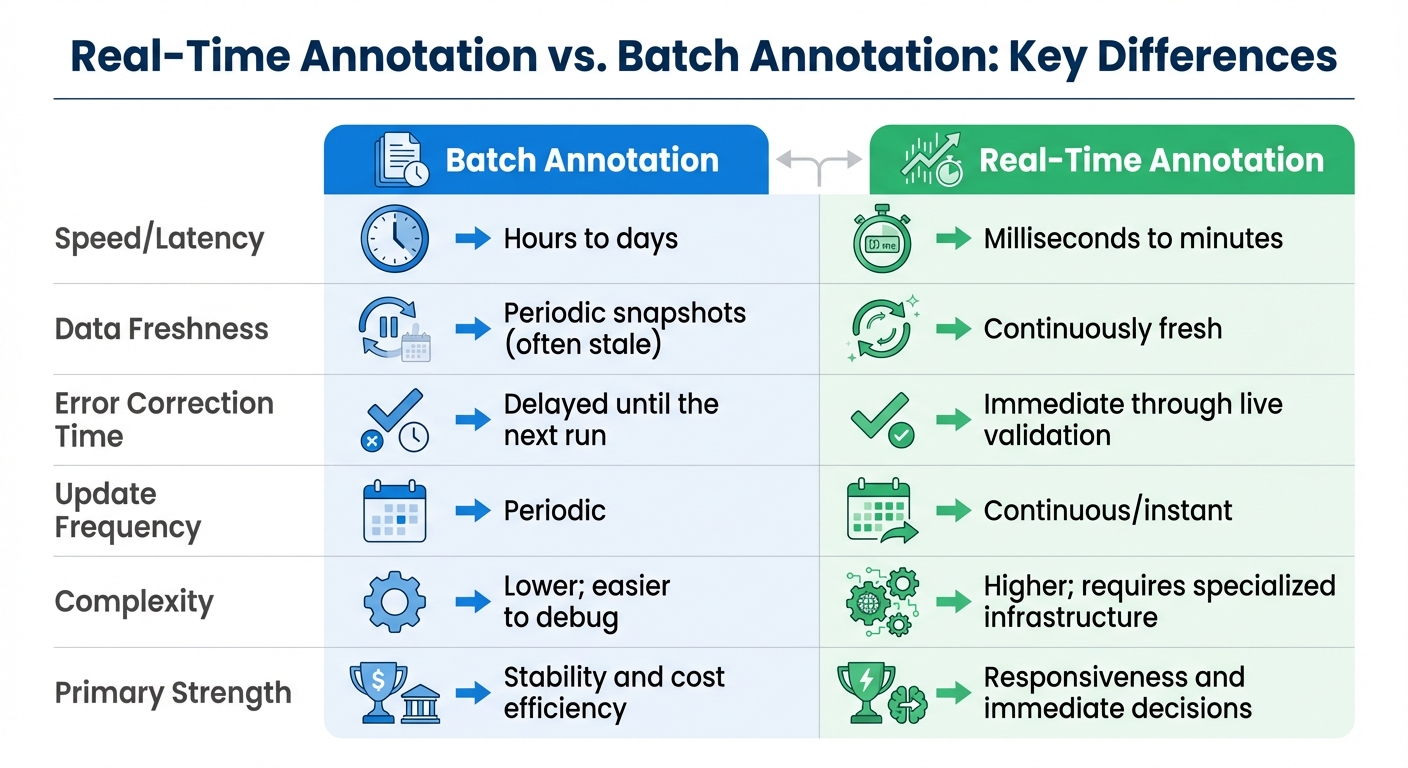
Real-Time vs Batch Annotation: Key Differences for AI Models
The main distinction between real-time annotation and traditional batch methods lies in timing. Batch annotation gathers data over a set period and processes it in bulk at scheduled intervals, which typically range from 4 to 12 hours. On the other hand, real-time annotation labels data instantly, allowing for immediate action. As GetAnnotator succinctly explains: "Batch annotation is retrospective, while real-time annotation is immediate".
This timing difference affects every stage of AI development. Batch processing is suitable for offline analysis but carries the risk of "stale data", where models rely on outdated information to make decisions. Real-time annotation eliminates this issue by continuously feeding labeled data into training pipelines without delay. This approach supports ongoing model retraining and ensures rapid adaptability.
Key Differences Between Real-Time and Batch Annotation
| Dimension | Batch Annotation | Real-Time Annotation |
|---|---|---|
| Speed/Latency | Hours to days | Milliseconds to minutes |
| Data Freshness | Periodic snapshots (often stale) | Continuously fresh |
| Error Correction Time | Delayed until the next run | Immediate through live validation |
| Update Frequency | Periodic | Continuous/instant |
| Complexity | Lower; easier to debug | Higher; requires specialized infrastructure |
| Primary Strength | Stability and cost efficiency | Responsiveness and immediate decisions |
Beyond speed and freshness, operational complexity is another critical difference. Batch workflows are easier to scale with fixed inputs, while real-time systems require robust engineering to handle variable data streams and fluctuating traffic. As Label Studio highlights: "Using batch when real-time is required can lead to stale decisions, while using real-time unnecessarily can introduce avoidable complexity and reliability risks". These operational factors play a major role in enhancing model responsiveness.
Benefits of Real-Time Annotation
Real-time annotation offers distinct advantages that directly impact AI model performance. Its speed enables continuous feedback loops, allowing models to learn from new data immediately instead of waiting for the next batch cycle.
This rapid adaptation is especially important in high-stakes scenarios. Suntec.ai notes: "Real-time annotation allows downstream systems such as fraud detection models or autonomous navigation engines to act on data instantly rather than waiting for batch processing". In industries where 90% of customers expect instant responses from customer service or financial fraud detection requires data freshness within 100 milliseconds, the faster processing of real-time systems can make all the difference.
Additionally, the continuous nature of real-time annotation prevents the backlogs that often slow down batch workflows. Teams can identify and correct annotation errors - like biases in facial recognition or sentiment analysis - on the spot, rather than discovering them days later. This immediate error correction helps maintain accuracy rates of 95% to 98%, ensuring models remain aligned with current conditions.
How to Implement Real-Time Annotation
Real-time annotation involves labeling incoming data as it's received. This is achieved by connecting live data streams to annotation tools and setting up automated workflows that keep models updated without manual intervention.
Step 1: Set Up Real-Time Data Pipelines
The backbone of real-time annotation is a low-latency pipeline that captures and processes data with minimal delay. Tools like Apache Kafka, Flink, AWS Kinesis, or SNS are commonly used for handling high-volume data streams. These tools allow you to process data quickly, which is crucial for applications where even milliseconds matter.
To make this work:
- Use cloud storage solutions like Amazon S3 to trigger labeling requests through pre-defined input and output topics.
- Handle sudden data surges with message queues like Amazon SQS and monitor queue delays using CloudWatch alarms to keep processing timely.
- Assign unique identifiers to data objects for proper tracking and to avoid duplicate processing.
- Use serverless scripts, such as AWS Lambda functions, to preprocess incoming data and consolidate human annotations into a final output.
As Amazon SageMaker Ground Truth explains:
"Streaming jobs are designed to be long-running workflows that keep running until you choose to stop them".
Once your pipeline is running smoothly, integrate human-AI workflows to maintain annotation quality.
Step 2: Create Hybrid Human-AI Annotation Workflows
Combining AI and human input ensures both speed and accuracy. Start by using an AI model to pre-label data, which can speed up workflows by up to 10 times compared to manual-only processes.
Here’s how to make it work efficiently:
- Use risk-based routing: Automatically approve high-confidence data while sending lower-confidence cases to humans for review. This can cut human review costs by 40% to 55% without sacrificing quality.
- For specialized fields like healthcare or autonomous driving, route complex cases to experts like radiologists or safety engineers.
- Design annotation interfaces with tools like thumbs-up/down buttons or "suggest edit" options to allow real-time corrections within the workflow.
- Set clear review timelines, such as under 2 minutes for live interactions and under 4 hours for asynchronous reviews.
This hybrid approach balances automation with human oversight for high-quality annotations.
Step 3: Build Continuous Model Retraining Loops
To keep your AI models improving, integrate continuous retraining loops. Real-time annotation only adds value if newly labeled data feeds directly into these pipelines. Teams that retrain models weekly see quality improvements 2.1 times faster than those on monthly cycles.
Key steps include:
- Use active learning to focus human review on data points where the model shows uncertainty or low confidence.
- Chain multiple labeling tasks together. For example, the output of an object detection task can feed into a semantic segmentation task, creating a system where each stage refines the previous one.
- Reduce model drift by ensuring each stage in the pipeline contributes to better accuracy over time.
As Sprintzeal highlights:
"When combining human review with AI estimated confidence scores on annotations, both the speed and the accuracy of the combined process is increased".
This setup creates a feedback loop that continuously sharpens your model's performance.
Step 4: Monitor and Optimize Annotation Quality
Maintaining high annotation quality requires both automated checks and human oversight. Automated tools can flag issues like missing labels, formatting errors, or invalid geometries (e.g., zero-area bounding boxes) before human review.
Here’s how to ensure quality:
- Keep a "Golden Set" of 200 to 500 verified labels to train new annotators and run regular calibration checks.
- Measure inter-annotator agreement using metrics like Cohen's Kappa or Fleiss' Kappa. Scores below 0.8 often indicate unclear instructions rather than poor performance.
- For critical data, use consensus labeling by assigning the same task to multiple annotators. Disagreements can be resolved by senior experts or majority vote.
- For high-risk tasks (e.g., legal or medical data), require reviews from two independent annotators supported by automated arbitration.
Finally, set up CloudWatch alarms to monitor metrics like ApproximateAgeOfOldestMessage and configure idle timers to stop jobs when no new data is detected for a set period. These measures help maintain efficiency while safeguarding data quality.
Benefits of Real-Time Annotation for AI Development
Faster Model Adaptation to Changing Data
Real-time annotation eliminates the delays of batch processing by feeding labeled data directly into training pipelines. This creates a continuous feedback loop, allowing models to quickly adapt to new data. This is especially critical in fast-changing fields like autonomous driving and fraud detection. For instance, YOLOv8 models used in agricultural monitoring can achieve a mean inference time of just 275.71 milliseconds per frame, while real-time frameworks maintain latency under 500 milliseconds. Active learning adds to this speed by identifying the most complex or informative data that requires human validation. This swift adaptability not only boosts model performance but also enables immediate adjustments to correct any emerging biases.
Reduced Bias Through Continuous Corrections
Real-time systems help prevent biases from becoming entrenched in training datasets by enabling constant monitoring and immediate corrections. As Humans in the Loop points out:
"AI bias is a serious issue. If an annotation team unknowingly labels data with bias, the AI model will adopt those mistakes".
With continuous feedback loops, annotators can maintain consistent labeling standards. Active learning further supports bias reduction by flagging ambiguous cases for review, while real-time annotation captures edge cases in live streams, ensuring models don’t overly rely on outdated patterns. This dynamic approach is particularly effective when managing large-scale data flows.
Efficient Processing of Large Streaming Datasets
Real-time annotation is designed to handle massive data volumes as they are generated, avoiding the delays that come with batch collection. This is achieved through parallel processing, which divides data into manageable chunks for simultaneous handling. Such efficiency allows systems to process petabyte-scale datasets without backlogs. In-memory processing further speeds things up by reducing reliance on slower disk operations, enabling systems to handle millions of events per second with millisecond-level latency. Notably, 86% of IT leaders now prioritize streaming technologies to improve agility and AI capabilities. AI-powered pre-annotation also plays a key role, allowing models to handle initial labeling while human validators focus on more complex cases.
Lower Costs and Less Manual Work
The hybrid approach of combining AI with human input not only speeds up annotation but also lowers costs. AI tools enable non-expert annotators to perform at near-expert levels when identifying fleeting or complex targets, reducing the need for expensive specialists. By concentrating human efforts on high-risk or ambiguous data, labor costs decrease significantly. Additionally, pretrained models within these frameworks can achieve high mean Average Precision scores after just 30 training epochs, cutting down on the computational resources needed for development. The continuous nature of real-time annotation ensures that models are always updated with fresh data, avoiding the expensive consequences of working with outdated datasets. This reduction in manual intervention leads to faster, more cost-effective updates for AI models.
Using Data Annotation Companies for Real-Time Services
To tap into the benefits of real-time annotation, teaming up with experienced providers is key to keeping your models both effective and flexible. Building your own infrastructure for real-time annotation can be a costly and time-intensive endeavor. For instance, hiring in-house annotators often comes with a 2-to-4-week recruitment delay, not to mention the added burden of managing schedules, quality control, and tool integration. For companies focused on continually improving their models, outsourcing this work simplifies the process. Professional annotation providers can deploy specialized teams in as little as 24 to 48 hours. They also offer pre-built connectors for popular streaming platforms, cutting down setup time and enabling smooth integration with continuous retraining systems.
The Data Annotation Companies directory is a helpful resource for finding providers that excel in real-time annotation workflows. These services consistently deliver high-accuracy results with minimal latency. Plus, subscription-based models often bring significant cost savings compared to maintaining an in-house team. This cost efficiency pairs well with the speed and flexibility needed for modern AI systems.
Many providers combine model-assisted labeling with tools like SAM and YOLO, tailoring these advanced methods to meet specific client needs. This hybrid approach can be up to 10 times faster than traditional manual labeling. Additionally, specialized annotators with expertise in areas like healthcare, finance, or autonomous driving ensure that the labels align with the unique requirements of these critical fields.
Before fully committing, it’s wise to run a pilot project to assess accuracy, speed, and communication quality. Opt for partners who are tool-agnostic and can adapt to your current workflow, avoiding the hassle of migrating data to proprietary platforms. Also, confirm that providers meet compliance standards like ISO 27001, GDPR, or HIPAA if your data involves sensitive information.
"The bottleneck is rarely the algorithm itself. The code is often ready long before the fuel - high-quality, labeled data - is available to power it".
The data annotation market is expected to grow at an annual rate of 26% through 2030, driven by a shift from focusing on big data to prioritizing better data that supports live model updates. Today’s platforms can handle multimodal streams within unified workflows, while continuous feedback loops feed annotated data directly into MLOps stacks for real-time model retraining and drift monitoring.
Conclusion
Real-time annotation is transforming the way AI systems learn, enabling them to integrate live data without the delays of batch processing. By labeling streaming data as it arrives, models can be updated instantly. This speed is essential for high-stakes applications like autonomous vehicles, fraud detection, and content moderation, where even a brief delay can lead to critical issues. Beyond improving performance, this approach also simplifies error correction, making it more efficient.
Hybrid workflows and continuous retraining play a key role in maintaining model accuracy. They allow for immediate error correction during the annotation process, reducing bias and enhancing overall performance.
"Data annotation is not a side task... it is a core AI activity. It is the primary mechanism by which we impart human knowledge to machines." – GetAnnotator
For businesses aiming to leverage these benefits effectively, working with experienced providers is crucial. The Data Annotation Companies directory is a valuable resource for finding services that excel in real-time workflows, domain-specific expertise, and secure operations. Whether dealing with IoT data streams or live video feeds, the right partner can ensure your models remain cutting-edge.
Real-time annotation is no longer optional - it’s a necessity for building and maintaining adaptive AI systems. Embracing this approach is a strategic step toward keeping your AI models competitive in an ever-evolving landscape.
FAQs
Do I really need real-time annotation, or is batch enough?
Whether you go for real-time annotation or batch annotation depends on what your AI application demands. Real-time annotation is perfect for scenarios where constant, up-to-date data is essential. It ensures labels are applied instantly, reducing the risk of outdated information affecting performance. On the other hand, batch annotation suits static datasets but can lead to delays or outdated insights - issues that could be problematic in applications like autonomous driving or live customer support. The choice comes down to how much accuracy and responsiveness your system requires.
What latency is realistic for end-to-end real-time labeling?
A practical target for end-to-end real-time labeling is keeping latency below 100 milliseconds. Tools like Apache Spark's real-time mode have been developed to tackle past challenges, enabling sub-100ms latency and boosting performance.
How do I prevent quality issues in live human-in-the-loop workflows?
To maintain high-quality standards in live human-in-the-loop workflows, it's essential to implement real-time monitoring. This allows you to identify and correct errors as they happen, minimizing the impact on your process.
Additionally, having clear annotation guidelines is crucial. These guidelines ensure consistency across tasks and help reduce the likelihood of mistakes. Pair this with regular quality checks and feedback loops to refine processes and improve overall accuracy over time.
By combining these strategies with human oversight, you can create a workflow that consistently delivers reliable, high-quality data.