Top Medical Image Annotation Services 2025
· Data Annotation
Compare top medical image annotation services, AI tools, and compliance for DICOM/NIfTI projects — evaluate accuracy and clinical validation for FDA-ready work.
Top Medical Image Annotation Services 2025
Medical image annotation is essential for training AI systems in healthcare. It involves labeling clinical images like MRIs, CT scans, and X-rays to help AI detect patterns and assist in diagnostics. In 2025, AI-assisted platforms significantly cut annotation time, with tools automating up to 80% of tasks.
Key Providers in 2025:
- Labellerr: Focuses on MRI, CT, X-rays, EHR, and genetic data.
- Supervisely: Simplifies collaboration for complex segmentation tasks.
- Cogito Tech: Offers radiologist-level annotations, excelling in organ segmentation and tumor detection.
- Anolytics: Scales quickly for large datasets with a 99% accuracy rate.
- Ango Hub (iMerit): Provides advanced tools for specialized imaging, supported by certified radiologists.
Quick Comparison:
| Provider | Modalities Supported | AI Tools | Certifications | Expert Validation |
|---|---|---|---|---|
| Labellerr | MRI, CT, X-ray, EHR, genetic data | AI-powered segmentation | Privacy-focused | Precision medicine |
| Supervisely | Medical imaging (e.g., DICOM) | Automated segmentation tools | Data security standards | Imaging ML specialists |
| Cogito Tech | CT, MRI, X-ray, ultrasound | ML-based organ segmentation | HIPAA, FDA, ISO 27001 | Radiologists, specialists |
| Anolytics | Radiology, pathology, genomics | Human-in-the-loop AI tools | HIPAA, GDPR, FDA | Medical professionals |
| Ango Hub | MRI, CT, pathology | Advanced voxel/masking tools | HIPAA, 21 CFR Part 11 | Board-certified radiologists |
When selecting a provider, prioritize compliance, clinical expertise, and support for specialized formats like DICOM and NIfTI. Your choice will directly impact the quality of AI diagnostics and patient outcomes.
DICOM Medical Image Annotation & Labeling Tool for Healthcare AI
Top Medical Image Annotation Services in 2025
In 2025, medical image annotation services combine cutting-edge AI technology with clinical expertise to deliver highly accurate and efficient results. Here's a look at some standout providers leading the way in this field.
Labellerr is recognized for its expertise in annotating MRI, CT, and X-ray images. Beyond imaging, it also handles electronic health records (EHRs) and genetic data, making it a key player in personalized medicine advancements. Supervisely offers a robust platform tailored for complex segmentation tasks, enabling seamless collaboration between technical teams and medical experts in real time.
For projects requiring specialized radiological knowledge, Cogito Tech and Anolytics are top choices. Both providers focus on high-precision tasks like organ segmentation and tumor identification. Anolytics, in particular, emphasizes rigorous quality checks and adheres to strict HIPAA guidelines to ensure patient data remains secure.
Ango Hub by iMerit provides a customized interface designed for annotating MRI, CT, cellular, dermatological, and pathology images. It also supports the development of specialized AI models. Backed by a workforce of over 5,500 professionals, iMerit has contributed to the enrichment of more than 20 million healthcare AI data points.
All these providers support widely-used formats like DICOM and NIfTI, maintain compliance with stringent regulations, and leverage AI tools that can cut annotation time by up to 90%. The best choice for your project will depend on your specific requirements - whether it's radiologist-level accuracy, support for emerging imaging techniques like whole slide imaging, or tools tailored to particular medical specialties.
Detailed Service Reviews
Here’s a closer look at the top providers, highlighting their strengths and areas of expertise in medical data annotation.
Labellerr
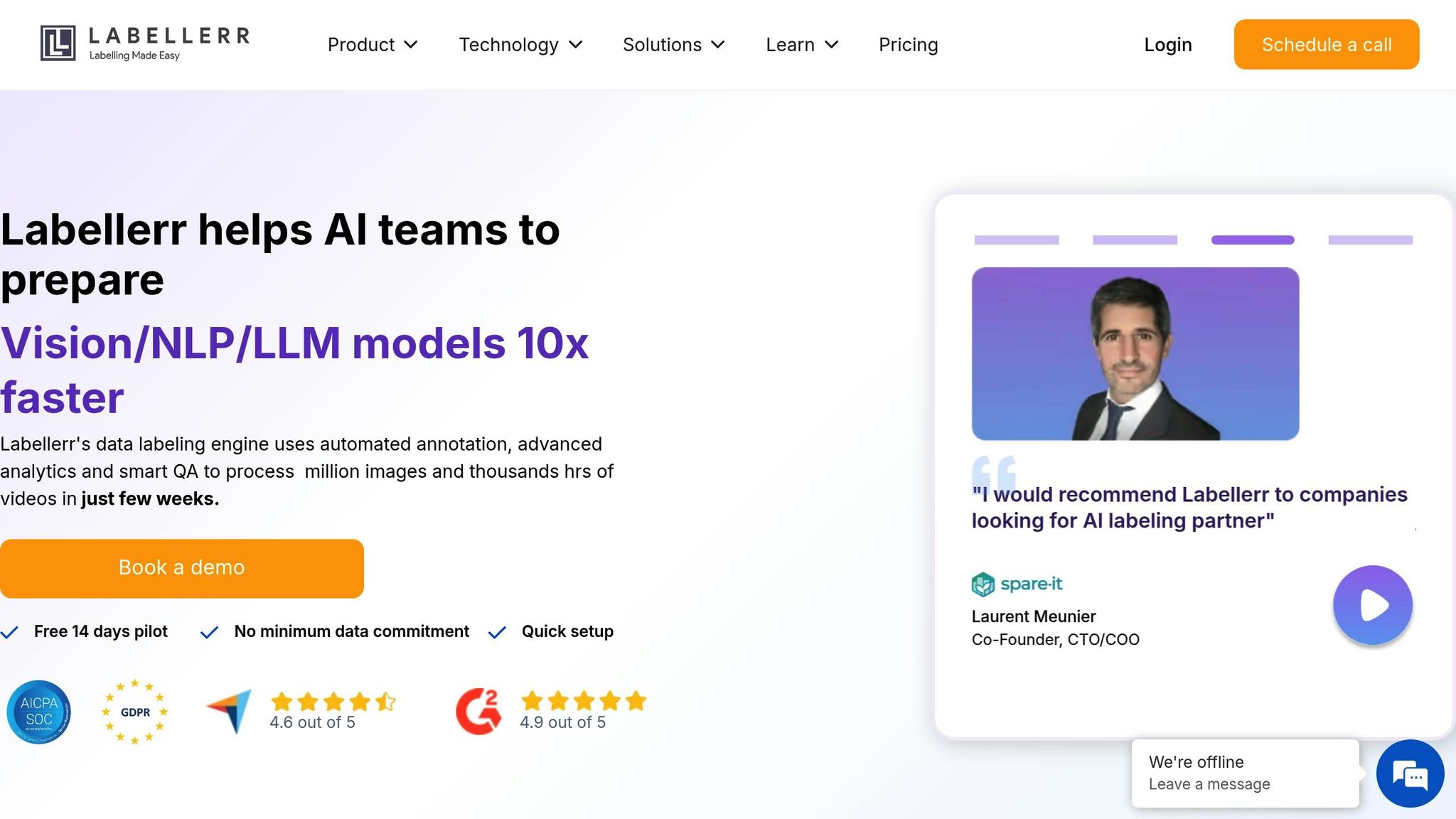
Labellerr takes a broad approach to healthcare data, excelling in standard medical imaging like MRI, CT scans, and X-rays. Beyond imaging, it also works with Electronic Health Records (EHRs) and genetic data, making it a strong choice for personalized medicine projects. By linking imaging data with patient histories and genomic information, it supports more tailored medical insights.
Supervisely
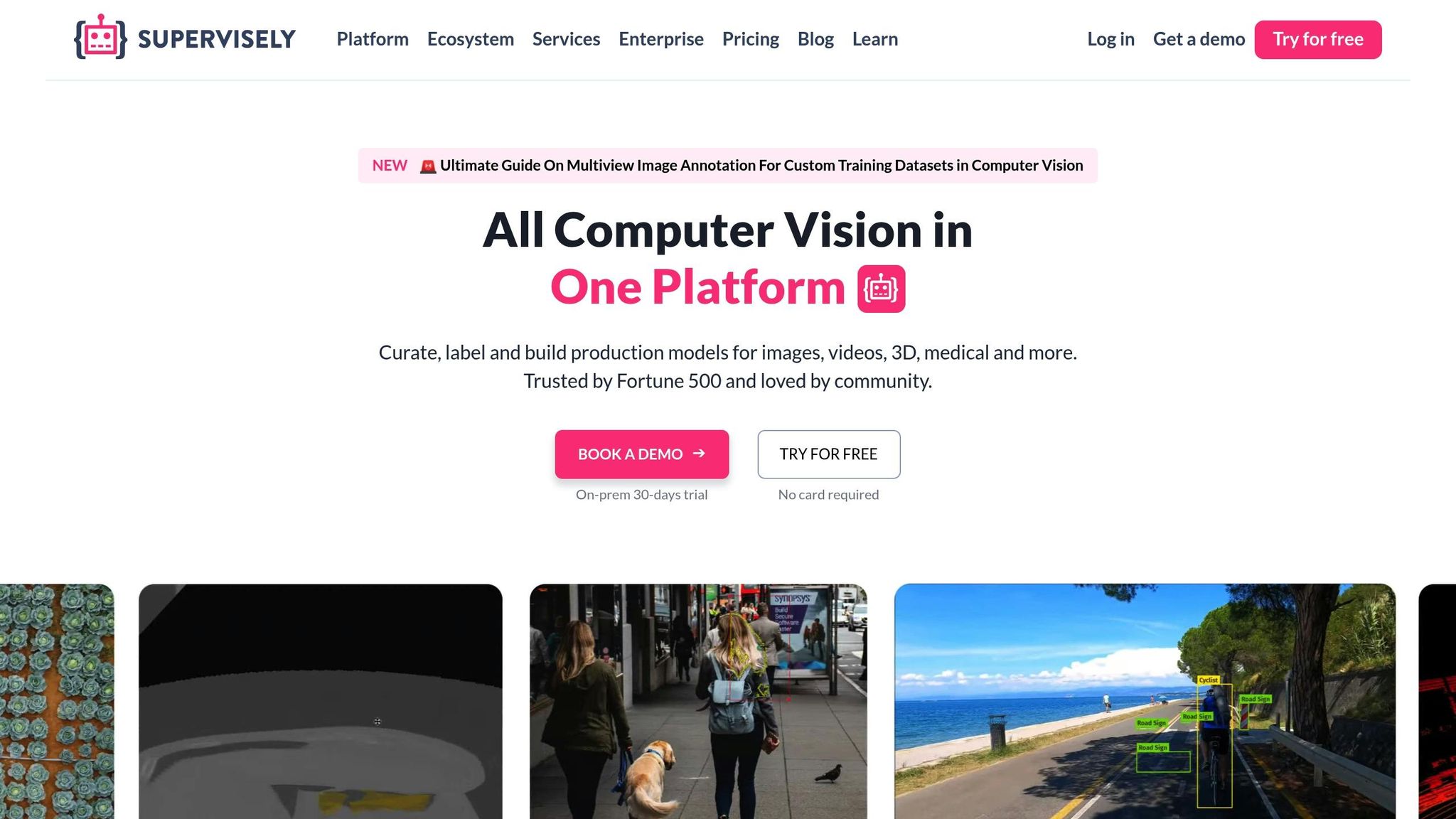
Supervisely is known for its user-friendly platform that simplifies collaboration among radiologists, data scientists, and clinical researchers. Its intuitive design reduces the learning curve, enabling teams to efficiently tackle complex segmentation tasks. This accessibility makes it a go-to option for teams with varying levels of technical expertise.
Cogito Tech
Cogito Tech integrates board-certified radiologists into its processes, ensuring annotations meet clinical standards. Its proprietary DataSum framework adheres to FDA 510(k) and CFR 21 Part 11 compliance, with a case study showing a boost in spinal MRI segmentation accuracy from 68% to 91%. The company also played a key role in developing the first FDA-cleared, AI-powered 3D spinal ultrasound by identifying critical bony landmarks. With over eight years of experience and a team of 1,500+ experts, Cogito Tech specializes in organ segmentation, tumor detection, and disease categorization.
Anolytics
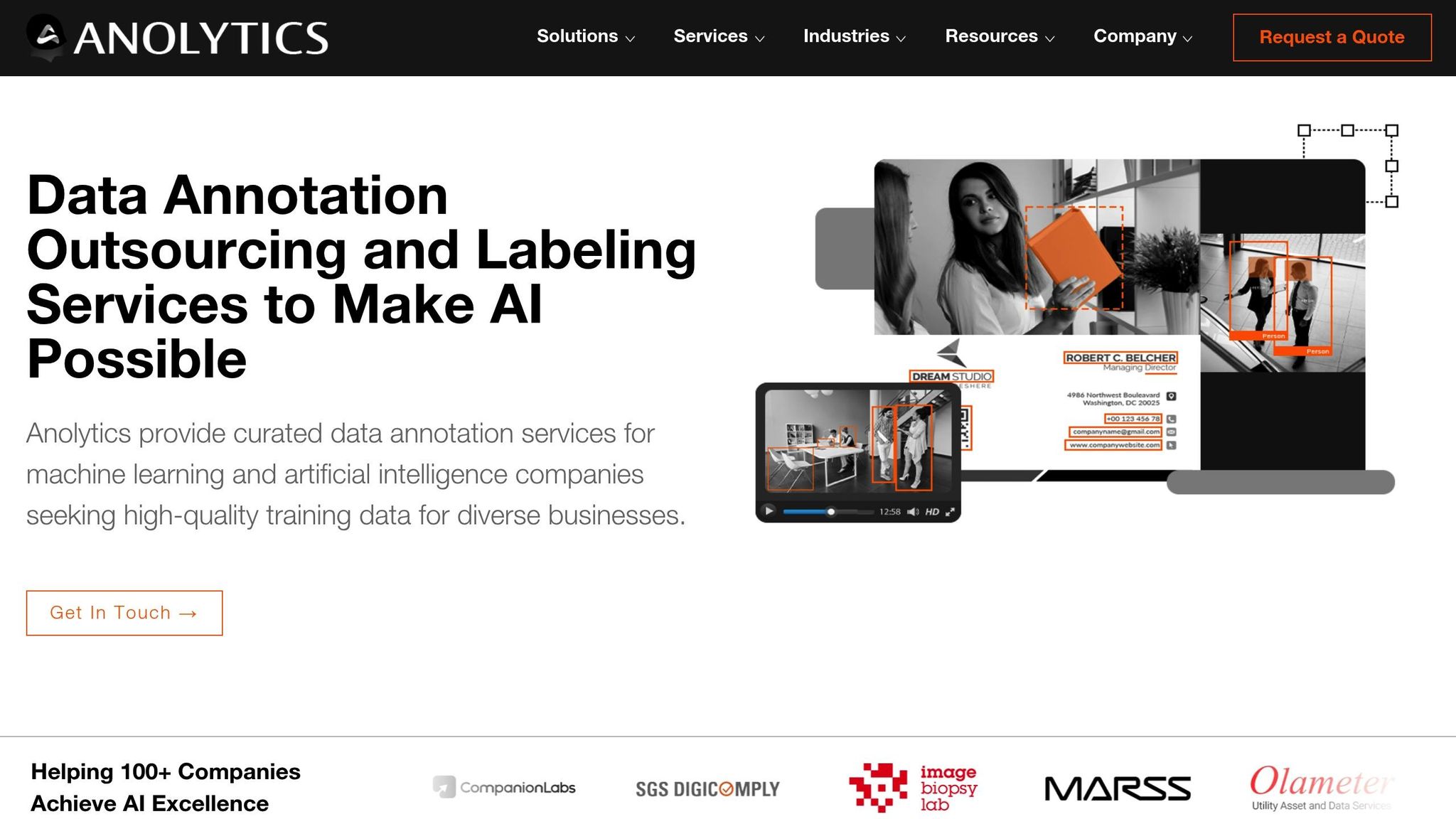
Anolytics offers scalable, round-the-clock solutions with a workforce of over 1,500 annotators. Its ability to handle large datasets quickly while maintaining quality is a major advantage. The company reports a 99% accuracy rate across its medical annotation projects. With cost-effective pricing through custom quotes, Anolytics caters to budget-conscious organizations. It supports a wide range of medical data types, including radiology images, pathology slides, genomics data, clinical text, and waveforms, all while maintaining HIPAA compliance and strong data security measures.
Ango Hub (by iMerit)

Ango Hub features specialized AI-assisted tools for medical imaging, such as Level Tracing, which selects voxels based on Hounsfield units in CT scans, and Magnetic Lasso for precise masking. The platform handles multiple medical formats like DICOM, NIfTI, NRRD, and TIFF, and includes advanced features like 3D reconstruction and multiplanar viewing. Backed by iMerit’s team of over 5,500 professionals, including US board-certified radiologists, Ango Hub ensures clinical reliability through expert validation. Its combination of advanced tools and expert oversight makes it ideal for projects involving FDA submissions or complex volumetric data analysis across radiology, pathology, and cardiology.
sbb-itb-cdb339c
How to Choose a Medical Image Annotation Service
Start by verifying regulatory compliance. Ensure the service provider adheres to HIPAA standards, which include data encryption, strict access controls, and de-identification practices. If your project involves FDA regulations, confirm compliance with 21 CFR Part 11, ensuring detailed audit trails are in place. Before finalizing any agreements, conduct a thorough legal review of the vendor's data processing policies and confirm that the data storage locations comply with healthcare data sovereignty laws.
Once regulatory standards are confirmed, assess the provider's clinical expertise. Look for board-certified professionals who can validate annotations to establish accurate clinical "ground truth." This is particularly important for complex tasks like identifying subtle fractures or performing 3D segmentation. Running proof-of-concept tests can help ensure the provider meets the necessary standards for modality and de-identification accuracy.
Next, evaluate the provider's ability to handle specialized medical formats and tools. The service should support formats like DICOM, NIfTI, and NRRD to maintain the integrity of images and their metadata. Advanced features such as windowing controls for tissue visualization, multiplanar reconstruction, and 3D volume rendering are also essential. These tools not only enhance functionality but also improve annotation efficiency.
Look for providers with certifications like SOC 2 Type II, ISO 27001, and HIPAA, as these indicate a strong commitment to data security. The vendor should also have a stable and well-trained team capable of scaling for high-volume projects. For instance, Anolytics is known for handling large datasets with its in-house team.
Finally, ensure the service includes multi-tiered quality assurance processes. Features like consensus tools to address inter-reader variability and FDA 510(k)-cleared image viewers for clinical interpretation are critical for maintaining accuracy and reliability.
Service Comparison Table
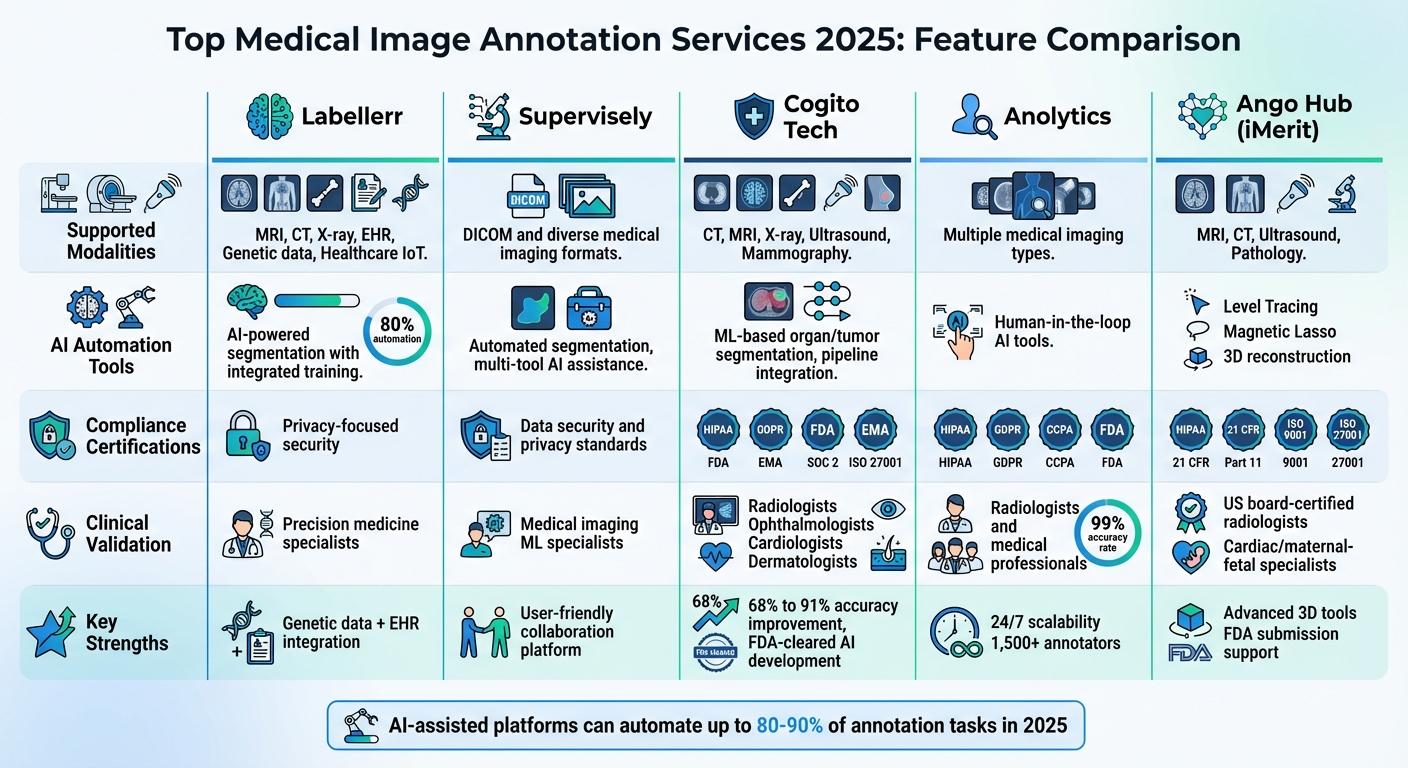
Comparison of Top 5 Medical Image Annotation Services 2025
This comparison breaks down key aspects to consider when selecting a medical image annotation service. The table below evaluates five providers based on imaging support, automation tools, compliance certifications, and clinical validation.
| Service | Supported Modalities | Automation Tools | Compliance Certifications | Clinical Validation |
|---|---|---|---|---|
| Labellerr | MRI, CT, X-ray, EHR, genetic data, Healthcare IoT | AI-powered bounding boxes, segmentation, object tracking with integrated training | Privacy and security focused | Precision medicine specialists |
| Supervisely | Diverse medical imaging formats including DICOM | Automated segmentation, multi-tool AI assistance | Data security and privacy standards | Medical imaging ML specialists |
| Cogito Tech | CT, MRI, X-ray, ultrasound, mammography | ML-based organ/tumor segmentation, pipeline integration | HIPAA, GDPR, FDA, EMA, SOC 2, ISO 27001 | Radiologists, ophthalmologists, cardiologists, dermatologists |
| Anolytics | Multiple medical imaging types | Standard AI tools with human-in-the-loop emphasis | HIPAA, GDPR, CCPA, FDA | Radiologists and medical professionals |
| Ango Hub (iMerit) | MRI, CT, ultrasound | Pathology-specific tools, expert-led AI streamlining | HIPAA, 21 CFR Part 11, ISO 9001, ISO 27001 | US board-certified radiologists, cardiac/maternal-fetal specialists |
Ango Hub stands out for its regulatory expertise, offering 21 CFR Part 11 compliance for FDA-regulated projects. Cogito Tech brings a broad range of international certifications, while Labellerr handles diverse data types, including genetic and IoT data.
Each service has unique strengths in automation. Labellerr combines annotation with integrated training, Cogito Tech embeds its tools directly into machine learning pipelines, and Supervisely focuses on automated segmentation for DICOM formats.
Clinical validation also varies widely across providers. Ango Hub employs US board-certified radiologists with specialized training in cardiac MRI and maternal-fetal health. Cogito Tech boasts a broad spectrum of experts, including radiologists, ophthalmologists, cardiologists, and dermatologists. These differences can significantly impact the accuracy and efficiency of complex diagnostic projects, where precision is crucial for patient care.
Conclusion
Choosing the right medical image annotation service is a critical step in ensuring the success of your healthcare AI project. The quality of annotations can directly impact outcomes, potentially making the difference between life-saving insights and diagnostic errors. As McKinsey highlights, "Data labeling is the biggest challenge in building effective ML models". This challenge becomes even more pressing in healthcare, where precision can directly affect patient outcomes.
From the services reviewed - Labellerr, Supervisely, Cogito Tech, Anolytics, and Ango Hub - each offers distinct advantages. One standout factor is clinical expertise. Providers that involve board-certified radiologists and specialized physicians ensure annotations are grounded in clinical reasoning, not just pattern recognition.
The rapid pace of technological advancements is also transforming the field. For instance, specialized medical AI toolkits can accelerate development across various imaging modalities by up to 80%, offering a significant edge in terms of efficiency and time-to-market.
When evaluating providers, focus on key features like DICOM support, audit-ready workflows, and certified experts. Ensure they comply with SOC 2 and HIPAA standards, including granular privacy controls to safeguard patient data. Don’t hesitate to ask for case studies that demonstrate their expertise in your specific imaging modality and clinical application. These steps align with the earlier analysis and provide a comprehensive framework for making an informed decision.
The foundation of successful healthcare AI lies in precise and reliable annotations. Your choice of annotation service will shape your AI model’s performance, regulatory compliance, and, most importantly, its impact on patient care. Take the time to evaluate your options thoroughly - this decision is pivotal.
FAQs
What should I look for when selecting a medical image annotation service?
When selecting a medical image annotation service, it's crucial to evaluate three main aspects: compliance and security, expertise and quality, and scalability and efficiency.
First, make sure the service adheres to HIPAA regulations and implements robust security protocols to safeguard patient data. This includes secure methods for file transfers and storage. Accuracy is equally important, so the provider should have medically trained professionals, like radiologists or pathologists, who can deliver precise and clinically meaningful annotations. They should also be equipped to handle various annotation types and work with complex imaging formats, such as X-rays, MRIs, CT scans, and ultrasounds.
Operational efficiency is another key factor. Look for a service that offers quick turnaround times, clear pricing structures, and the capacity to manage large datasets. Providers with customizable workflows and dedicated project managers can streamline the annotation process while ensuring consistent, high-quality outcomes.
How are AI tools in 2025 making medical image annotation faster and more accurate?
AI tools in 2025 have transformed the way medical image annotation is handled, cutting down the time and effort needed to turn raw medical scans into polished, high-quality datasets. Thanks to intelligent pre-labeling, these platforms can automatically generate rough outlines, masks, or key points for medical images. Instead of starting from scratch, human experts now refine these pre-generated annotations, boosting efficiency by an impressive 30–50% while still meeting the rigorous precision standards required in clinical settings.
On top of that, advanced features like deep-learning-based segmentation algorithms can process entire image series in just seconds. This means teams can handle thousands of images with ease, scaling up their operations without sacrificing quality or security. Many of these tools also come equipped with active-learning systems, which focus on the most challenging cases first. This approach not only improves the accuracy of AI models but also speeds up their development by as much as 80%. Together, these advancements are driving rapid progress in medical AI and paving the way for faster clinical adoption.
Why is clinical expertise essential for medical image annotation services?
Clinical expertise plays a key role in medical image annotation, ensuring that the labeling of intricate medical data is both accurate and meaningful. Professionals such as radiologists and pathologists bring extensive knowledge of anatomy, disease progression, and imaging technologies like MRI, CT, and X-rays. This depth of understanding allows them to spot subtle abnormalities, reduce the risk of misinterpretation, and produce precise annotations that enhance the quality of AI training datasets.
Moreover, clinicians are well-versed in healthcare regulations, including HIPAA and FDA standards, ensuring that data is handled ethically and in compliance with legal requirements. Their ability to address ambiguous cases and provide detailed metadata further strengthens AI models, making them safer and more dependable for diagnostic purposes. Opting for services that emphasize clinical expertise results in higher-quality outcomes and more reliable AI-powered diagnostic tools.